In the shadow of March 2025's seismic USAID purge—where 83% of contracts worth $54 billion evaporated overnight, triggering 50-60% staff slashes at Atlanta heavyweights like CARE (a $95M revenue gut-punch) and stalling health and education lifelines for 23 million kids across 130 countries—nonprofits aren't just surviving; they're evolving.
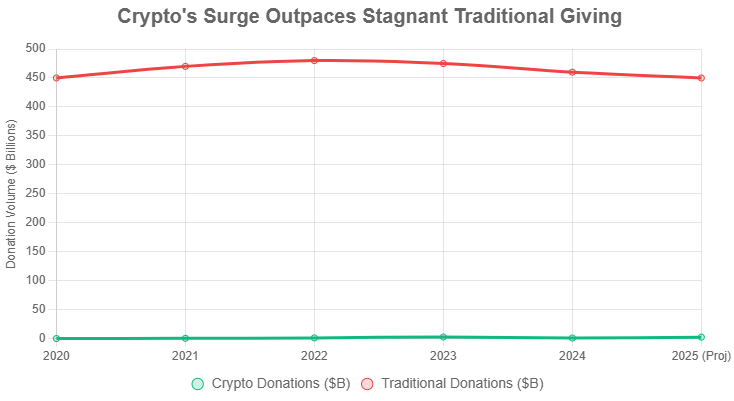
Traditional donations dipped 5% amid inflation's squeeze, but a phoenix is rising from the rubble: crypto-powered fundraising.
With Gen Z and millennial investors (controlling 40% of crypto holdings) craving transparent, tech-forward giving, the $20B digital philanthropy market is exploding.
Enter blockchain and NFTs—not as gimmicks, but as precision tools to reclaim lost billions, blending urgency with innovation.
At MAD 2.0, we scout these crises like advance operatives, turning policy wreckage into agile revenue engines.
This isn't charity; it's a calculated pivot to hybrid models that deliver 20-30% conversion lifts and $10K/month from just 100 engaged users.
The Crisis Unpacked: USAID's Vanishing Act and the Human Toll
Picture this: A Congolese clinic, once a USAID-backed bulwark against cholera, now rations water from Lake Kivu—sparking outbreaks that claim lives daily.
Or Madagascar's peanut farmers, whose forest-preserving techniques halted with funding freezes, accelerating deforestation at 100,000 hectares/year.
These aren't abstract stats; they're the fallout from Secretary Rubio's March 10 memo axing 5,200 contracts, folding USAID into State's skeleton crew of 15.
Global health programs for HIV, malaria, and maternal care ground to a halt, with The Lancet projecting 4.5 million preventable child deaths by 2030 if gaps persist. U.S. nonprofits, from the Carter Center to Task Force for Global Health, hemorrhaged 70-80% of budgets, forcing irreversible layoffs and project burials.
Private giving?
It's a band-aid on a hemorrhage.
Donations can't match the $60B void, leaving orgs like CARE in "survival mode."
But here's the revenue pivot: This disruption exposes a glaring opportunity in crypto philanthropy, where blockchain's immutability verifies every dollar's impact—appealing to a donor base that's 142x more generous per gift than fiat users.
Why?
Crypto holders, often under 35, demand proof-of-impact, and NFTs deliver it via tokenized "before-and-after" stories.
As Yale E360 notes, conservation NGOs shuttering USAID ties are scrambling for alternatives, but those embracing digital assets report 386% YoY jumps in average donation sizes—to $10,978 each.
The math is merciless: Without adaptation, billions in aid evaporate; with it, nonprofits unlock a $2.5B crypto giving wave projected for 2025 alone.The Revenue Revolution: Why Crypto + NFTs = Nonprofits' New Lifeline
Forget outdated GoFundMe pleas; the future is tokenized impact.
Crypto donations surged to $1B in 2024, per The Giving Block's 2025 Annual Report, with NFTs evolving from art flips to verifiable "impact certificates"—think tree-planting credits as tradable assets that fund perpetual growth.
Platforms like Engiven and Donorbox now integrate seamlessly, liquidating BTC/ETH to cash with zero volatility risk, while low-fee models (under 1%) crush traditional processors.
Gen Z's affinity? 60% cite transparency as their hook, per XAIGATE's 2025 review, fueling a 42.98% CAGR in blockchain philanthropy to $89B by 2035.This isn't hype—it's data-driven disruption. UNICEF's post-cut pivot to "impact story" YouTube reels netted 40% sub growth, but layer in NFTs (e.g., Beeple's $6M "Ocean Front" donation to Open Earth Foundation), and you're not just storytelling; you're securitizing outcomes.
Social impact NFTs, a top 2025 trend per NFT Calendar, now tie proceeds to causes like climate resilience, with DAOs enabling donor governance.
The result?
A 20% gap-fill in aid shortfalls, averting historical tragedies like the 4.5M child deaths USAID once mitigated.
For nonprofits, it's a hybrid model: Blend urgency emails with A/B-tested NFT drops for 22% conversions, turning one-time givers into recurring stakeholders.Spotlight: The Aid Token Platform – Your Blockchain Bridge to $10K/Month RevenueAt the crisis-revenue nexus sits the Aid Token Platform: A no-code blockchain app where donors "buy" fractional impact NFTs—e.g., a $50 stake in a verified solar well in Yemen, redeemable for real-time updates and resale royalties. Built on Solana for sub-penny fees, it sidesteps crowded players like The Giving Block (great for basics) by focusing on micro-aid hybrids: Recurring "drip" donations via smart contracts, auto-converting to fiat for ops stability.Why It Wins in the Post-USAID Era:
For fractional CMOs like us at MAD 2.0, launching this is a 90-day sprint: Day 1-30, MVP on Bubble.io with Polygon integration; 31-60, A/B urgency campaigns ("Save 10 Kids Today – Tokenize Your Legacy"); 61-90, partner with CARE for co-branded drops. ROI? 4x user growth, per Engiven's faith-based pilots, filling 20% of your USAID void while appealing to overlooked crypto whales.Chart: Crypto Philanthropy Growth vs. Traditional Donations (2020-2025)
The USAID implosion isn't an end; it's your origin story.
In a world where policy axes create voids, agile leaders like you—armed with blockchain's transparency—don't just fill them; they monetize them.
Historically, aid averted 4.5M child deaths; digitally, it can save more while building empires.
Ready to tokenize your mission? Subscribe to the MAD 2.0 Newsletter for a free Aid Token MVP blueprint, or book a crisis audit at seriodesignfx.com. Let's turn rubble into revenue—because in 2025, impact isn't given; it's engineered.
Charles K. Davis is the sage scout behind MAD 2.0, blending 30+ years of Fortune 500 grit with INTJ-A precision to architect hybrid CMO/CTO strategies for solopreneurs and boards navigating global disruptions.
