In the evolving landscape of digital entertainment, specialized applications focused on microdramas—short, serialized narratives typically lasting 60 to 120 seconds—present substantial revenue potential. These platforms, exemplified by ReelShort, DramaBox, and TikTok's PineDrama, capitalize on addictive, mobile-optimized content to generate billions in annual earnings. As of 2026, the global microdrama market outside China is projected to exceed $9.5 billion by 2030, with a compound annual growth rate surpassing 28 percent. This section outlines key revenue opportunities and provides a structured playbook for launching and monetizing such an app, drawing on industry analyses and best practices to support sustainable business growth.
Microdrama apps thrive on a combination of low production costs, high user engagement, and diversified monetization strategies. The format's appeal lies in its gamified structure, where initial episodes are often free, encouraging users to invest in subsequent content through various payment mechanisms. Industry data indicates that more than 60 percent of global microdrama revenue derives from subscriptions or transactional payments, with average revenue per user (ARPU) reaching up to $20 per week or $80 per month. In 2025, leading apps like ReelShort achieved approximately $1.2 billion in gross consumer spending, a 119 percent increase from the prior year, while DramaBox generated $276 million. Projections for 2026 suggest in-app micro-series revenue will more than double to $7.8 billion, driven by expanding adoption in regions such as the United States and Latin America.
Key revenue models include:
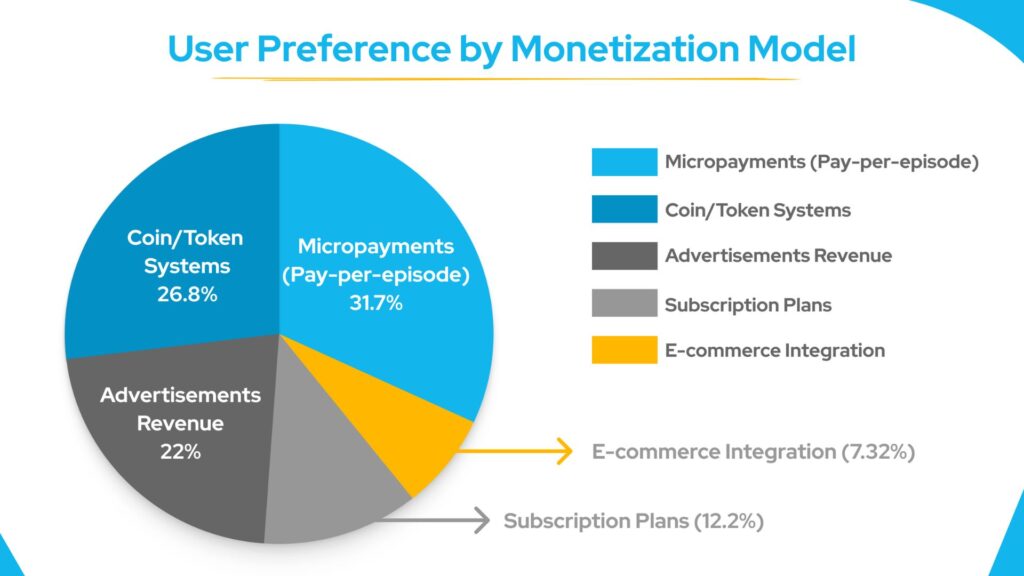

These models emphasize the need for balanced strategies to mitigate risks, such as high churn from paid acquisition, while leveraging low-competition entry points for independent creators.
Launching a microdrama app requires a methodical approach, integrating market insights, technical infrastructure, and user-centric design. The following playbook synthesizes established guidelines, enabling efficient deployment with minimal coding through white-label solutions like Muvi or Enveu. It is structured in sequential steps to facilitate scalability and profitability.
The following infographic outlines a high-level app launch process, adaptable to microdrama contexts:
.webp)
By adhering to this playbook, entrepreneurs can navigate the low-competition environment of microdrama apps, harnessing their massive income potential while addressing challenges like customer acquisition costs. This framework positions such ventures for long-term success in a market poised for continued expansion.
Webflow can serve as a viable foundation for hosting a microdrama-style entertainment platform, particularly in its initial stages or for a web-based MVP, but it is not designed as a full native video streaming application. Webflow excels at building visually sophisticated, responsive websites with integrated e-commerce and membership features, yet it imposes limitations on direct video hosting, streaming scalability, and advanced app-like functionality.
Webflow does not natively host videos beyond small file sizes (typically limited to 10–30 MB per upload, depending on the element type), and it relies on third-party providers for robust video delivery. Services such as Vidzflow (a Webflow-specific integration), Vimeo, YouTube, Bunny Stream, or Cloudflare Stream enable seamless embedding of high-quality, ad-free videos with custom players, analytics, and interactive elements like in-video CTAs. These integrations support paywalled or membership-gated content when combined with tools like Memberstack or Webflow's native Memberships feature.
Regarding the "Video Store for e-commerce" you mentioned, Webflow offers built-in e-commerce capabilities that allow the sale of digital products, including access to video series or episodes. This functions as a "video store" by treating serialized microdramas as purchasable items (e.g., individual episodes, season bundles, or subscription access). You can set up product pages, integrate payment processors (e.g., Stripe), and gate content behind logins. For enhanced membership functionality—such as tiered subscriptions, recurring payments, and restricted access—Webflow's native Memberships or integrations like Memberstack provide the necessary paywall mechanics without requiring custom development.
Webflow's pricing structure in 2026 supports low-barrier entry for prototyping and launching, with costs scaling based on features required:
Total realistic entry-level cost for a basic paywalled video series site: $50–100/month (Webflow E-commerce Standard + video host + membership tool), plus one-time setup effort. This avoids custom app development, which can range from $25,000+ for white-label OTT platforms (e.g., Muvi Shorts at $339/month) to higher for fully native mobile apps.
Webflow itself does not generate content, but it can host and distribute an AI-generated microdrama series effectively. Use external AI tools (e.g., for script generation via models like Grok or similar, video synthesis via platforms such as Runway ML, Synthesia, or Pika Labs, and voiceovers via ElevenLabs) to produce episodes quickly and at low cost. Upload or embed the finished vertical videos (optimized for mobile) via a third-party host, then organize them in Webflow CMS collections for episodic display, with paywalls restricting full access.
This approach leverages Webflow's strengths in design and e-commerce while minimizing development overhead. For a true mobile-first "app" experience (beyond web), consider progressive web app (PWA) features in Webflow or eventual migration to dedicated OTT builders. If scalability becomes a concern (e.g., high concurrent streaming), dedicated platforms like those mentioned earlier may prove more efficient long-term.
