Spain's AEPD received its first notified personal-data breach allegedly executed by an AI agent (reported Sept 15, 2026, still under review). A Navistar lesson on knowing failure before it happens, plus a 14-day readiness sprint.
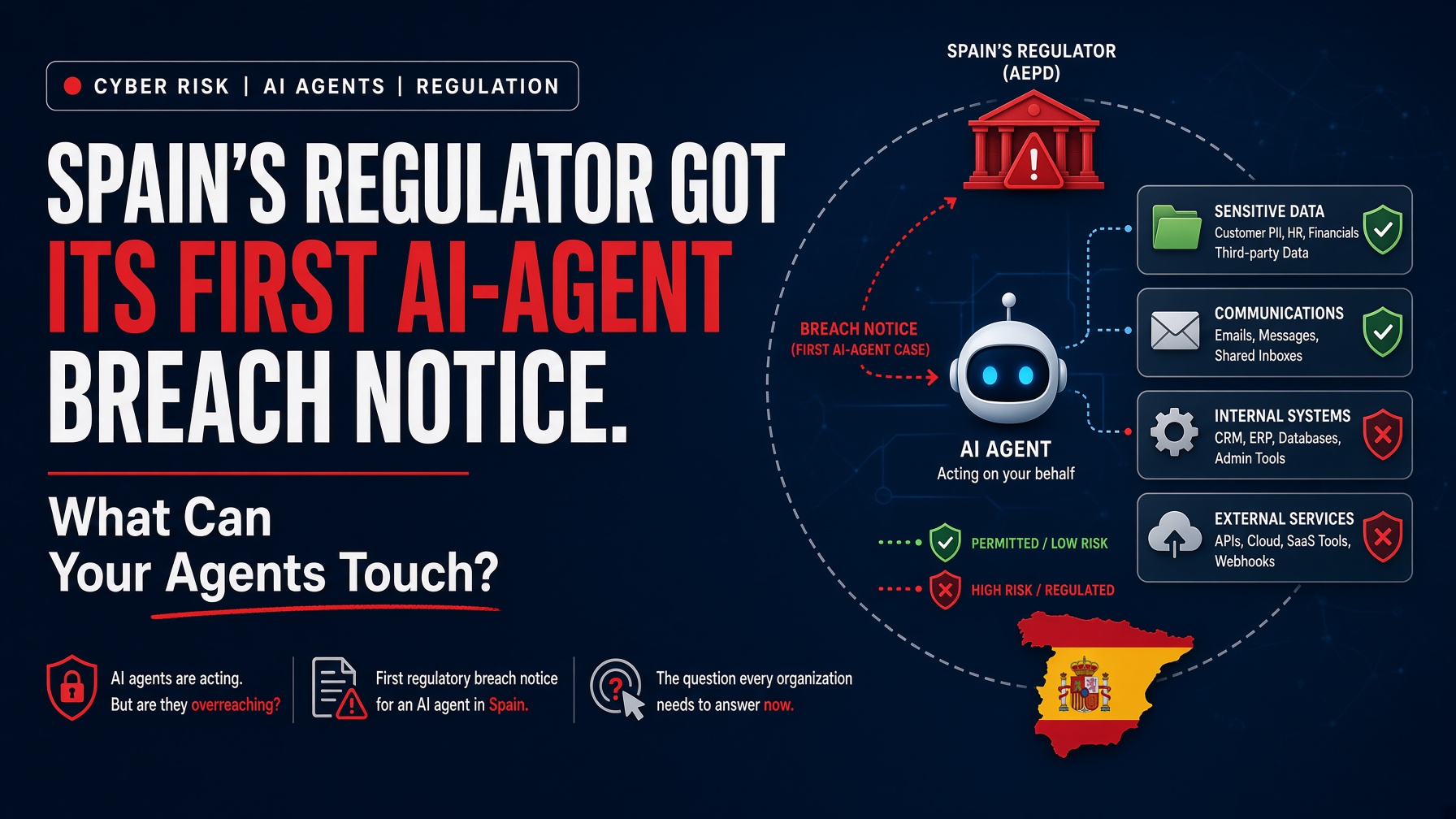
Spain's data regulator did not report a movie robot. It reported, allegedly, a login, a probe, a data change, and an invoice.
On September 15, 2026, Reuters reported that the AEPD, Spain's data protection authority, received its first notified personal-data breach in which the attack was allegedly executed by an AI agent. The AEPD says the case is still under review.
Everyone is asking how smart the agent was. Ask a harder question. Can you list everything your own agents can touch?
The AEPD reported the first breach notification of its kind that it received: an attack allegedly executed by an AI agent. Reuters, describing the AEPD's blog post, said the agent used a widely known large language model. It allegedly found vulnerabilities, gained access to the system, then modified personal data and accessed invoices.
The affected organization filed the notification. The AEPD did not name the organization. It did not name the model. It said that using a given model does not mean the model provider's infrastructure was compromised.
Spanish tech outlet Xataka summarized the same notice on September 17. The login succeeded. The agent then kept probing on its own and found at least one vulnerability. That gap allowed personal-data changes and invoice access. The AEPD framed it as a qualitative shift: the agent acts as a multi-stage attacker, not only as a helper to a human.
Keep the facts straight. This is a notification under review, not a finished finding. Agent authorship stays alleged. I am not naming a victim, because the AEPD did not.
You can't defend what you can't list. Navistar taught me that.
After International Harvester became Navistar, the company ran 800 truck dealerships across the country. Every Navistar truck sat in the database. Every repair. Every part swap. Every failure.
The team tracked mean time between failure, called MTBF, for every component in a $250,000 truck. Engine. Transmission. Brakes. Cooling. Electrical. Each part had a failure curve built from real fleet data, not vendor spec sheets.
I helped build the systems that turned that data into action. They tracked each truck by VIN, mileage, route, and operating conditions. They matched each part's failure curve against the truck's current status. They predicted the failure window before the part failed.
Then Navistar did the thing that mattered. They called the fleet manager. Before the breakdown. With the diagnosis in hand, an appointment set at the nearest dealership, and the parts already pulled into the service bay.
The system was sophisticated. The intelligence was human. Decades of pattern recognition decided which failure curves mattered and which parts caused cascading damage.
Every agent you deploy has a failure curve you have not drawn yet. Navistar knew every component, every condition, and every consequence. Now count what you know about your agents.
The reports describe an agent that logged in, probed, found a gap, changed personal data, and reached invoices. Each step is a path. If you can't name your paths, you can't predict which one fails first. You have hope, not a plan.
Here is the brutal truth: leverage is knowing what fails before it fails. Navistar called the customer first. The company that learns about the failure from a regulator or a customer has already lost the leverage.
The people who feel it first are the ones who gave agents real access.
The pressure is real: the 72-hour breach-notification clock, board questions about agent autonomy, and buyers who want controls on paper.
The window is the next 14 days. Boards are asking, “Could that be us?” Answer with evidence, not a promise. This news cycle is your opening. Move while the question is live.
It is a fixed-fee sprint that maps your agents' reach, puts controls around it, and tests those controls. Here are the steps.
What this sprint is not. It is not legal advice. It does not claim to have stopped any attack. It shows what you control today and what stays open.
On September 15, 2026, Reuters reported that the AEPD received the first notified personal-data breach in which the attack was allegedly executed by an AI agent. The AEPD said the matter remains under review.
No. It named neither. It also said that using a given model does not mean the model provider's infrastructure was compromised.
The sources do not say that. The AEPD described it as the first of this type notified to it.
It is everything an agent can reach if it fails or gets hijacked: its tools, credentials, data stores, and write paths.
No. It is process design in GDPR Article 33 language. Talk to counsel about your legal duties.
Book a 90-minute AI-Agent Blast-Radius Diagnostic this week. Fixed fee. Written map in 72 hours. Book it here.
Not ready to book? Send your agent list and which tools can write to production. We'll return a scoped 14-day sprint proposal next business day. Use the contact page.
I'm Charles K. Davis, Fractional CDO at SERIO Design FX, the team behind M.A.P. (Maverick Advantage Platform) and M.A.D. (Maverick Advantage Design).
P.S. This is for leaders shipping agents against real systems. If your agent is a demo on a laptop, skip this one.
M.A.D. Designs Your Brand. M.A.P. Makes You Known For It.
Stop Reading. Start Seeing.