Citi cut more US risk, compliance, KYC, and fraud roles in an automation push. A Navistar lesson on why a human still owns the call, plus a 14-day plan for SaaS founders selling trust automation.
Citi is automating the desks that decide who gets stopped, flagged, or cleared. The machine can make the check. It cannot make the phone call. I helped build a system that proved that difference across 800 dealerships.
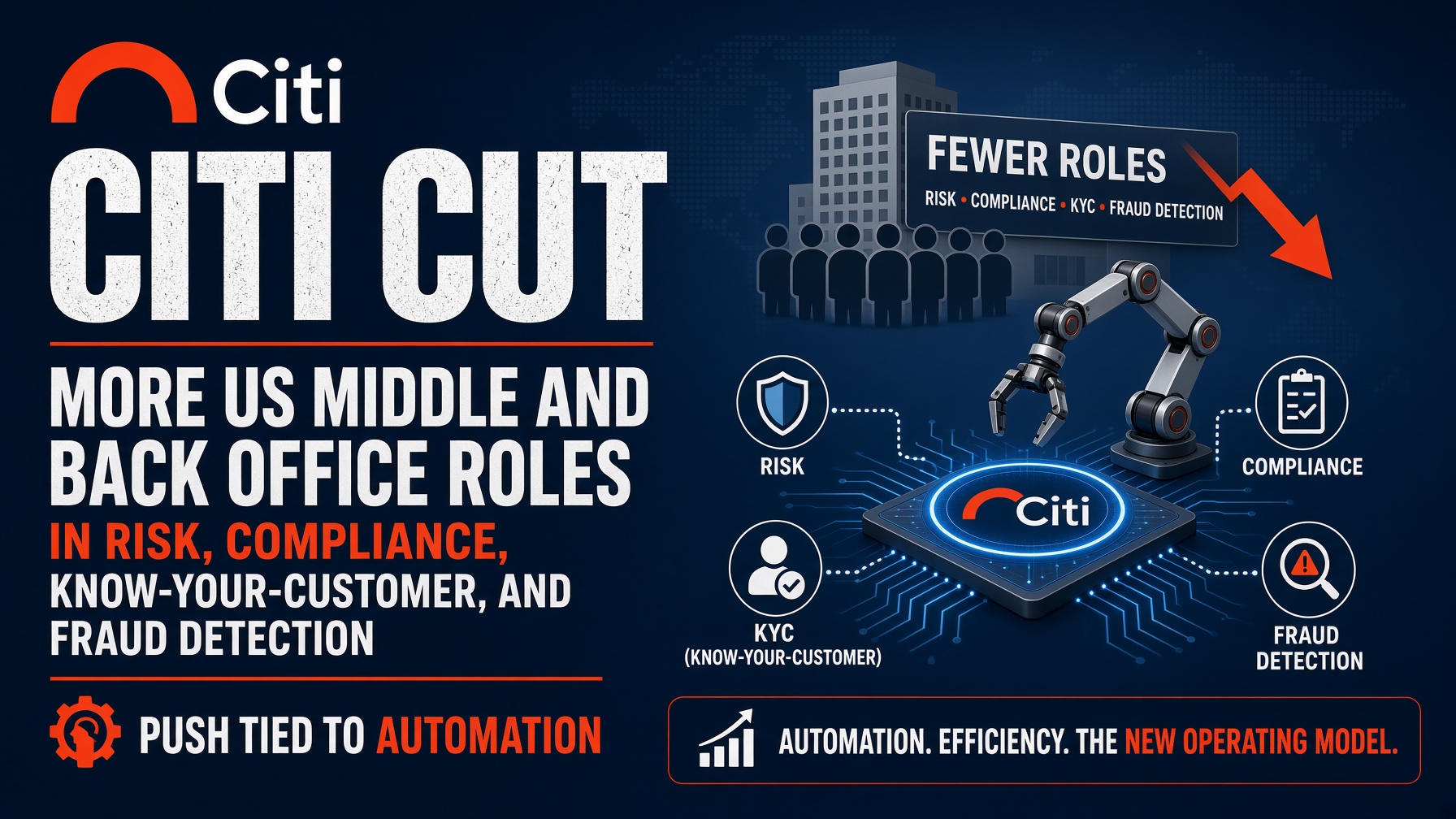
Citi cut more US middle and back office roles in risk, compliance, know-your-customer, and fraud detection, and tied the push to automation.
Reporting on October 1, 2026 said the latest cuts hit work in places including Tampa, Florida, O'Fallon, Missouri, and Florence, Kentucky. The functions named were regulatory reporting, risk, compliance, KYC, and fraud detection. A spokesperson said the bank remains committed to reducing global headcount in 2026. Some of the people leaving had been at the bank for more than two decades.
Citi did not publish a headcount for this round. Earlier reporting this year put three New York rounds at about 820 people, and about 7,000 positions reduced in the first half. Those are not this week's number. Do not mix them.
The system can predict the failure. A human still has to own the call. I learned that at Navistar.
After International Harvester became Navistar, the company ran 800 truck dealerships across the country. Every truck sat in the database. Every repair. Every part swap. Every failure.
We tracked mean time between failure, called MTBF, for every major part in a $250,000 truck. Engine. Transmission. Brakes. Cooling. Electrical. Each part had a failure curve built from real fleet data, not vendor spec sheets.
I helped build the systems that turned that data into action. They tracked each truck by VIN, mileage, route, and operating conditions. They matched each part's curve to the truck's current state. They predicted the failure window before the part broke.
That was automation. Serious automation, decades before anyone said "AI."
But here is the part people forget. The system did not call the customer. A person did.
Navistar called the fleet manager before the breakdown. With the diagnosis. With an appointment set at the nearest dealership. With the parts already pulled into the service bay. A human being picked up the phone, explained the call, and owned it.
Why did that matter? Because a fleet manager does not trust a printout. He trusts a person who can answer, "Why my truck? Why now? What happens if I wait?" The system found the risk. The human earned the trust.
And the people who decided which failure curves mattered had decades of pattern recognition. They knew which parts caused damage down the line. The machine ran their judgment at scale. It did not replace it.
Citi is automating the functions that hold trust.
A faster KYC check is a feature. Nobody minds that. A fraud stop with no human who can explain it is a brand event. A customer's card gets frozen at the worst moment. Their wire gets held. Their account gets flagged. They call. And the person who used to explain it, with 20 years of judgment, is gone.
When those people walk out, their pattern recognition walks out with them. The system keeps running. The judgment behind it gets thinner.
The operators on those desks feel it first.
Then the clients who need a control to hold and need someone to explain it when it does.
Then every SaaS founder selling automation into compliance, risk, KYC, or fraud. Your buyers just watched a major bank make this move. Their boards will ask a simple question: when our automated system stops a real customer, who owns that decision?
If your product cannot answer that, your buyer cannot defend buying it.
Here is the brutal truth: you can automate the task and still owe the decision.
Navistar automated the prediction. It never automated the accountability. That is why the system made money instead of making enemies. The fleet manager heard from a human who knew his truck.
Cost stories do not survive a bad stop on a real customer. One wrongly frozen account, posted online with a screenshot, undoes a year of "efficiency" messaging. The product that wins this cycle is the one that can point to the human who still owns the exception.
Name the decision your software must never make alone, and put that sentence where the buyer can see it.
That one line is worth more than a dozen speed claims right now. Your buyer needs a sentence they can repeat to their board.
Because buyers are reading the Citi headlines this week. Every risk and compliance leader is asking whether their vendors can show a human in the loop. The founder who answers in the next 14 days sets the standard. The one who waits gets measured against it.
Reporting on October 1, 2026 said Citi cut more US middle and back office roles in regulatory reporting, risk, compliance, KYC, and fraud detection, tied to an automation push.
Citi did not publish a headcount for this round. Earlier 2026 numbers, such as about 820 people across three New York rounds, are separate. Do not mix them in.
You can automate the checks. The risk sits in the exceptions. When a real customer gets stopped, someone has to explain and own the call.
Show the decision your software never makes alone, the human role that owns it, and what the customer hears when the system stops them.
Yes. Navistar automated the prediction across 800 dealerships, but a human still called the fleet manager. The machine scaled judgment. It did not replace it.
If your product automates a trust function, your first line should name the human who still owns it. Start with the free audit at seriodesignfx.com/audit.
Want that message built into your site and turned into founder authority content? That is what M.A.P. (Maverick Advantage Platform) does. It turns what you know into content on a schedule, so your buyer trusts you before the first call. Use the contact page to scope it.
I'm Charles K. Davis, Fractional CDO at SERIO Design FX, the team behind M.A.P. (Maverick Advantage Platform) and M.A.D. (Maverick Advantage Design).
P.S. This is for founders selling into risk, compliance, KYC, or fraud. If your software does not touch a customer decision, skip this one.
M.A.D. Designs Your Brand. M.A.P. Makes You Known For It.
Stop Reading. Start Seeing.