Last week Korn Ferry approached me. My AI research uncovered the executive-search trust crisis: ~40% of retained searches never hire, and 40–50% of placed executives fail within 18 months — while the black-box assessments keep selling.
Last week Korn Ferry approached me. Most people would feel flattered. I got suspicious. So I did the one thing the executive search industry is not built for you to do: I checked the receipts.
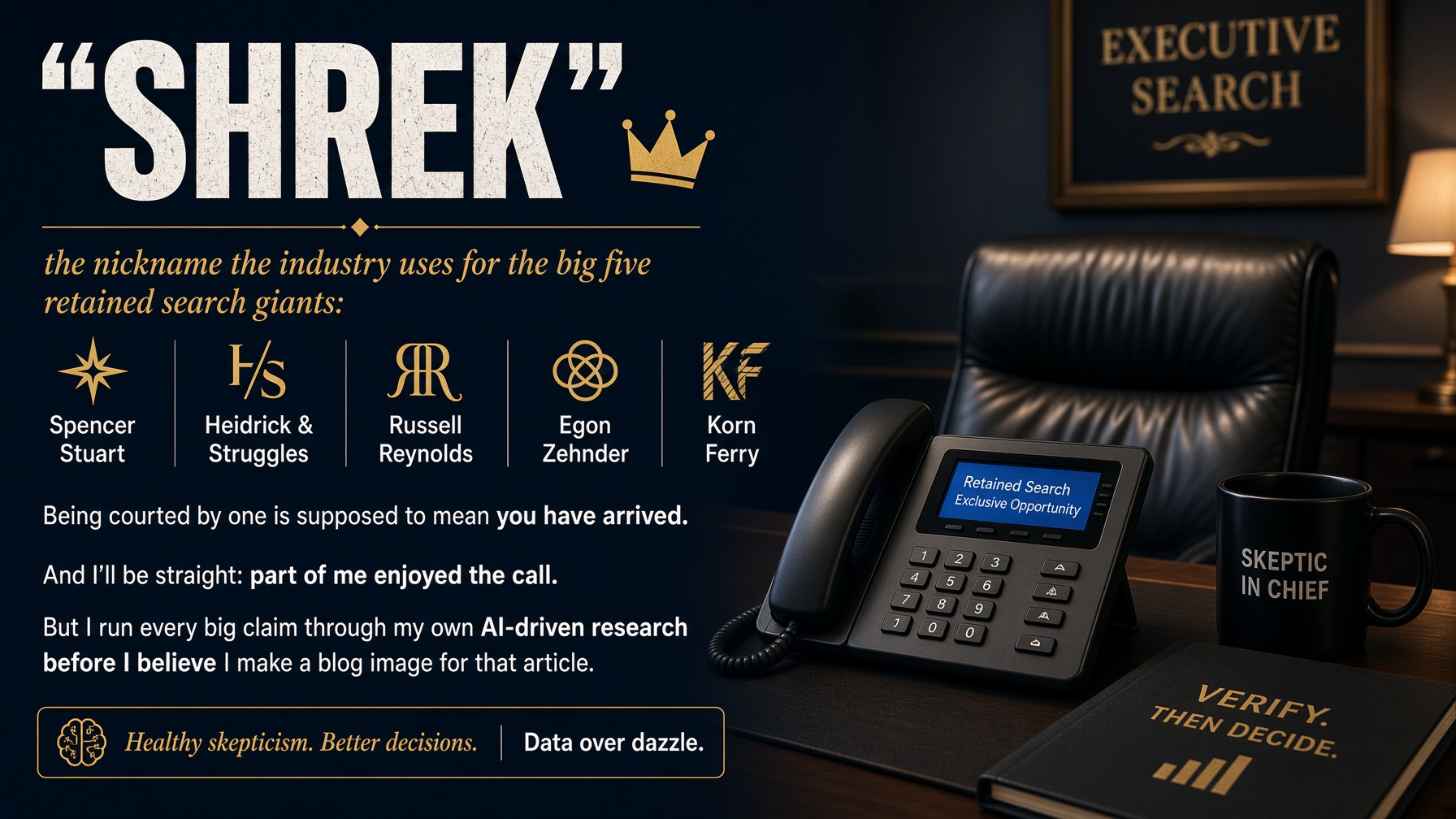
Korn Ferry is one of the “SHREK” firms — the nickname the industry uses for the big five retained search giants: Spencer Stuart, Heidrick & Struggles, Russell Reynolds, Egon Zehnder, and Korn Ferry. Being courted by one is supposed to mean you have arrived. And I’ll be straight: part of me enjoyed the call. But I run every big claim through my own AI-driven research before I believe it. What that research pulled up about how these firms actually perform was disturbing enough that I stopped feeling flattered and started writing.
Here is what the data says. And here is why any executive getting the same call should read it before they say yes.
The big search firms don’t just find candidates. They grade them. Korn Ferry’s flagship tool is the Four Dimensional Executive Assessment, KF4D. It measures four things: competencies (skills and behaviors), experiences (career history), traits (personality), and drivers (what motivates you). The firm calls it science-based, points to forced-choice question formats built to stop candidates from faking answers, and cites technical manuals claiming solid reliability and a database of millions of assessments.
Every SHREK firm has its own version of this. A proprietary model. A branded framework. Jargon only the creators fully understand. These tools decide whether you get placed with a client — and whether you get added to the firm’s ongoing “stable” of executives they market to companies for years.
Here’s a number that tells you how much power these frameworks hold. Among companies that keep a formal, company-wide definition of “high potential,” roughly 39% use the CEB/Gartner model and about 31% use Korn Ferry’s. Two consulting frameworks quietly define what “leadership potential” even means across a huge share of corporate America. That is not a small tool. That is the grading rubric for the whole C-suite.
Clients and candidates don’t fully trust these assessments because almost nobody outside the firm can see how they work — and the results don’t hold up the way the sales pitch promises.
Start with the science. Many of these proprietary models have never been put through strong, independent validation in top-tier peer-reviewed journals. The firms tend to prioritize selling the tool over publishing it for outside scrutiny. Worse, the leading models contradict each other. Korn Ferry and CEB/Gartner emphasize different factors and sometimes disagree on what actually predicts a good leader. They can’t all be right. And a lot of what gets labeled “potential” — intelligence, drive, personality — is really just a repackaged measure of current performance, which quietly inflates how predictive the tool looks.
Then there’s the black box itself. Senior executives sit down, answer a battery of forced-choice questions, and get sorted by a methodology they’re not allowed to inspect. Many placed executives openly say they distrust it. Some think a person operating at their level shouldn’t need a personality quiz to prove they can lead. And here’s the quiet part: some firms don’t even apply their own tools to their own people consistently. That’s a credibility gap you could drive a truck through.
To be fair, Korn Ferry pushes back hard. They cite internal validation studies, claims of reduced bias, and outcome data — for example, that CEOs recommended through their process showed around 18% attrition over three years versus roughly 34% in the broader CEO population. That’s their number, from their research. The problem isn’t that the claim is impossible. The problem is that you have to trust them to check it. Independent, audited retention data from these firms is almost nowhere to be found.
This is the part that made me put the phone down. Because whatever the assessments claim, the real-world outcomes are ugly — and they’ve stayed ugly for decades.
Roughly 40% of retained executive searches never result in a hire at all. By some industry counts, it’s closer to half. A search that does complete takes about 123 days on average. And that’s the good outcome.
Now look at what happens after the placement. Independent research — Leadership IQ, Harvard Business Review, and study after study since — finds that 40% to 50% of externally hired executives fail within 18 months. They leave, or they’re pushed out. The first six to twelve months are the danger zone. Early exits inside six months are so common that the firms build 6- and 12-month replacement guarantees into their contracts. Read that again: the guarantee exists because they already know how often it breaks. The average cost of one failed executive hire runs somewhere between $1 million and $2.7 million once you count the fee, the lost productivity, the disruption, and doing the whole search over.
So here is the crisis in one sentence. The most prestigious firms in the industry, using the most expensive proprietary assessments money can buy, place executives who fail up to half the time inside 18 months. The black box did not fix the problem. It just made the failure look scientific.
If a SHREK firm approaches you, don’t confuse being assessed with being valued. You’re being measured against a proprietary success profile for a client mandate and sorted into a pool. That’s not an insult — it’s just not the coronation it feels like. Ask the questions the brochure hopes you won’t. What is your firm’s actual placement completion rate? What’s your real 18-month retention number, audited by someone who doesn’t work for you? Can I see how this assessment is scored, or am I just supposed to trust the box? A firm that dodges those questions has answered them.
If you’re a company hiring through one of these firms, stop treating the proprietary framework as proof. Demand transparent, verifiable outcome data — completion rates and multi-year retention, not promotion-rate cherry-picks. Insist on an assessment method you and the candidate can actually understand, built on common, published standards instead of in-house jargon. And put as much money into onboarding the executive as you put into finding them, because that’s where the 18-month failures are really lost.
The whole industry is standing on the same fault line the ad agencies hit and the consulting firms hit before them: heavy reliance on proprietary black boxes, paired with outcomes that don’t match the marketing. There’s a 90-day window right now — before the next wave of AI-driven scrutiny makes this common knowledge — for the firms and executives who move to transparency to own the high ground. After that, everyone’s just defending the box.
SHREK is the industry nickname for the five dominant retained executive search firms: Spencer Stuart, Heidrick & Struggles, Russell Reynolds, Egon Zehnder, and Korn Ferry. They handle a large share of C-suite and board-level searches and rely on proprietary assessment frameworks to evaluate candidates.
KF4D is Korn Ferry’s Four Dimensional Executive Assessment. It measures four dimensions — competencies, experiences, traits, and drivers — using forced-choice question formats, and it’s marketed as science-based with a large proprietary database. It’s used to evaluate candidates for client placements and for inclusion in the firm’s executive network.
Independent research from Leadership IQ, Harvard Business Review, and others consistently finds that 40% to 50% of externally hired executives leave or are terminated within 18 months, with the first 6 to 12 months being highest-risk. Separately, roughly 40% of retained searches — by some counts nearly half — never result in a hire at all.
Partly, but not transparently. The firms publish internal validation studies and technical manuals, but many models lack strong independent validation in top-tier peer-reviewed journals, and leading frameworks sometimes contradict each other on what predicts leadership success. That gap between marketing claims and outside verification is the core trust problem.
Treat it as a real opportunity, not a verdict on your worth. You’re being assessed against a proprietary profile and added to a candidate pool. Ask for the firm’s completion rate, audited multi-year retention data, and transparency on how the assessment is scored before you invest heavily in the process.
I don’t write this because I’m against executive search. I write it because I got the call, and instead of getting flattered, I asked for proof. The proof isn’t there. Not the transparent, independent, auditable kind that a million-dollar decision deserves.
The firms that survive the next five years won’t be the ones with the fanciest proprietary box. They’ll be the ones who trade the black box for a framework a client and a candidate can both actually read — built on common standards, not private jargon. That shift is coming whether the SHREK firms lead it or get dragged into it.
If you’re an executive being courted, or a company betting a seven-figure hire on someone else’s black box, that’s the work I do as a Fractional CDO — cutting through the proprietary theater and building assessment and positioning your people can actually verify. Book a consult and let’s look at the receipts together.
Stop Reading. Start Seeing.
— Charles K Davis, Fractional CDO
P.S. If a firm’s whole pitch is “trust our proprietary science,” ask them for their audited 18-month retention number. Watch what happens to the room. The ones who show you the data are the ones worth your time. The rest are selling you a box.