Hyundai Motor Group reached out to lead their Georgia innovation project covering energy, aerospace, and AI healthcare. Here is the full evidence stack and the revenue playbook it reveals.
I did not pitch Hyundai. I did not apply for a position. I did not work a referral network.
Someone in South Korea had been reading my LinkedIn content. Content produced through MAD 2.0. Crisis-to-revenue intelligence, published consistently, built on 25 years of Fortune 500 pattern recognition. That person passed it to a Hyundai decision-maker. That decision-maker reached out asking me to lead their strategic innovation project on their Georgia, USA campus.
That is the proof of concept for everything I teach.
But the story here is not about me. The story is what the Hyundai project reveals about where the real money is moving in 2026 and who is positioned to capture it.
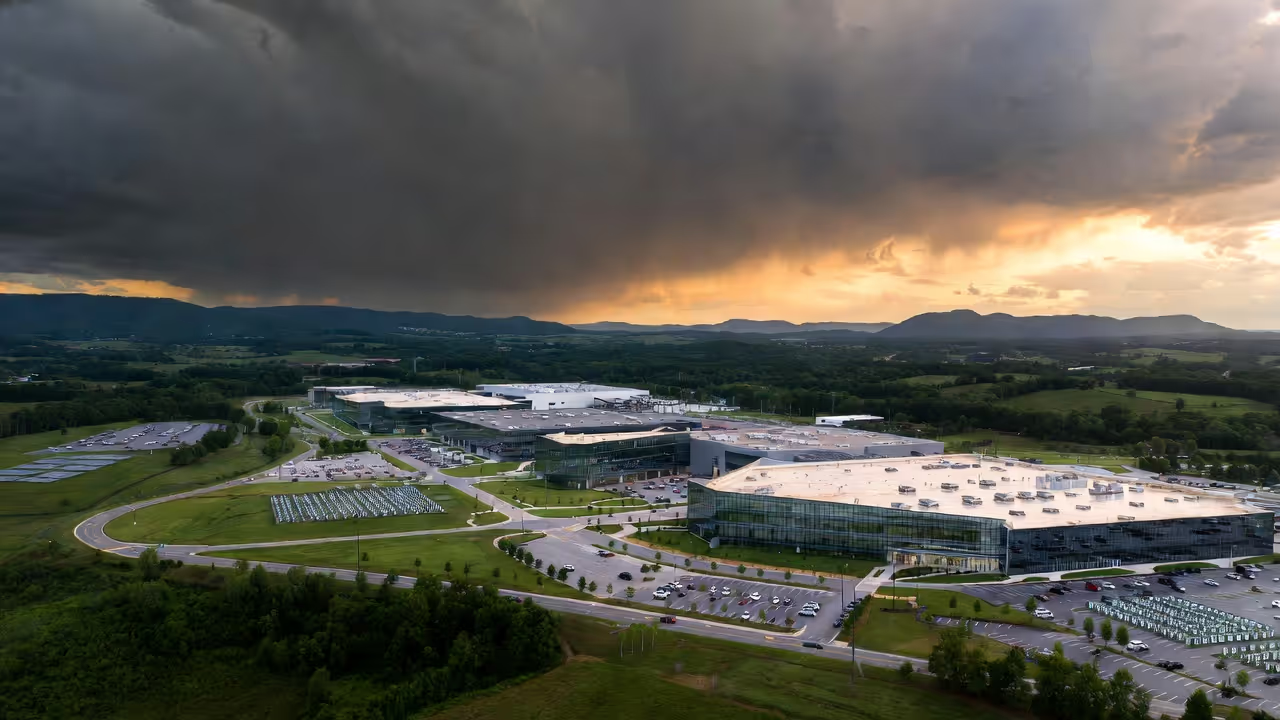
Hyundai Motor Group is advancing what they call a Strategic Innovation Project for Future Industrial Ecosystems. The project is centered on their Georgia, USA campus and prioritizes three sectors.
Pillar 1: Energy and Infrastructure. Focusing on smart energy systems and sustainable infrastructure, this pillar explores efficient, secure, and low-carbon energy solutions for industrial parks to support the stable operation of future manufacturing systems.
Translation for investors and operators: Hyundai is spending real capital to insulate a major U.S. industrial campus from the kind of energy market volatility the Iran conflict just triggered. They are not theorizing. They are building. And they need U.S. talent with the expertise to execute it.
Pillar 2: Aerospace and Advanced Technology. Combining advanced manufacturing capabilities with high-end technology application scenarios, this pillar explores synergy and innovation opportunities for aerospace-related technologies within industrial systems.
Translation: Hyundai is onshoring aerospace manufacturing capability onto American soil. The geopolitical risk that the Iran strikes made viscerally obvious to every board in the world is something Hyundai has been building against for months. They are ahead of the curve. And they are looking for U.S. professionals who can operate at that level.
Pillar 3: Healthcare and Artificial Intelligence. By integrating AI with medical technology, this pillar promotes health risk prediction, digital health management, and the construction of a healthcare industrial ecosystem, thereby enhancing the overall operational efficiency and employee well-being of the industrial park.
Translation: AI-integrated healthcare is not a future trend. It is a current capital investment at one of the world's largest industrial conglomerates. The companies building AI health infrastructure today own the workforce resilience advantage of the next decade.
Here is the uncomfortable truth most American professionals are not tracking.
The global investment thesis has shifted. For decades, capital chased cheap labor offshore. That era is ending. Geopolitical risk, supply chain fragility, and the realization that distance from market creates vulnerability have reversed the calculus for major industrial players.
Hyundai is building in Georgia. Not South Korea. Not Vietnam. Georgia.
They are not alone. This is a pattern. Major foreign conglomerates are investing in American manufacturing infrastructure at a pace not seen since the post-World War II industrial buildout. The Iran conflict accelerated it. The reshoring policy environment enabled it. The talent base available here justifies it.
What they are missing is U.S. professionals who understand both the strategic context and the technical execution required to lead cross-sector innovation at this scale. That gap is the opportunity.
Window 1: Smart Energy Infrastructure Consulting and Implementation.
The Iran crisis sent European gas prices surging. Every industrial operator with U.S. facilities is running the same math: what does our energy exposure look like if this escalates? The answer is usually terrifying. Smart energy systems, demand forecasting, renewable integration, and grid resilience are no longer sustainability initiatives. They are board-level risk management.
The professionals and firms that can audit energy infrastructure and map a 90-day mitigation plan are in extraordinary demand right now. Hyundai confirmed this is a capital priority. That capital is coming from somewhere. Position yourself to be where it lands.
Window 2: Domestic Aerospace Advanced Manufacturing.
The U.S. aerospace supply chain has been under stress since COVID. The Iran conflict added another layer of geopolitical uncertainty to parts sourcing from overseas suppliers. Every prime contractor and Tier 1 supplier is accelerating their domestic sourcing strategy.
The companies that can demonstrate domestic advanced manufacturing capability in the next 90 days are gaining supplier agreements that will generate revenue for the next decade. Hyundai is building aerospace manufacturing capability into their Georgia campus. They need partners who already understand the ecosystem. That is a relationship market. And relationship markets reward those who show up first.
Window 3: AI-Integrated Healthcare Systems for Industrial Campuses.
This is the most underpriced opportunity in the entire playbook. Every major industrial campus is sitting on a workforce healthcare problem. Injury rates, chronic disease management, mental health support, and productivity loss from health-related absences cost manufacturers billions annually.
AI-integrated healthcare systems that predict health risks, manage chronic conditions proactively, and reduce emergency interventions have an ROI story that pays for itself in 18 months or less. Hyundai is building this. Industrial campuses across the country need it. The companies that can deliver an implementable AI health management system will close contracts in Q2 and Q3 that their competitors will not see for two years.
Here is the pattern I keep seeing. U.S. professionals with exactly the expertise Hyundai is looking for are invisible to the decision-makers doing the hiring. Not because they lack the skills. Because they have not built a public record of their strategic depth that travels without them.
The person who recommended me to Hyundai had never met me. They had read my content on LinkedIn. Content built through the MAD 2.0 platform, structured through the Davis Method, published consistently across the crisis-to-revenue intelligence framework I have been developing for years.
My LinkedIn content did the outreach for me. To a market I could not have reached through a cold email or a pitch deck. That is not luck. That is system design.
The MAD 2.0 platform, now running on Windows via Claude Cowork, is built to create exactly this outcome for professionals with genuine domain expertise. Not content automation. Synthetic Intelligence: your pattern recognition, systematized and made visible to the decision-makers who need it.
Week 1-2: Audit your positioning against the three pillars. Energy infrastructure. Aerospace advanced manufacturing. AI-integrated healthcare. Which of these maps to your deepest expertise? That is your primary positioning window. Own one completely.
Week 3-4: Build your public record. Decision-makers at Hyundai-scale organizations do not respond to cold outreach. They respond to evidence of expertise that travels. Three to five LinkedIn posts built on your specific crisis-to-revenue pattern recognition in your chosen pillar. Not generic content. Specific, defensible, insider intelligence that demonstrates you have lived this problem.
Month 2: Make yourself findable to the right buyers. The companies looking for talent in these three areas are not searching LinkedIn profiles. They are reading content. Being recommended by people who have read content. The MAD 2.0 content flywheel creates the compounding signal that puts your name in the recommendation chain when the right conversation happens in the right boardroom.
Month 3: Convert the visibility into revenue. A Revenue Intelligence Audit. A fractional engagement. A project leadership role. The form the opportunity takes depends on your positioning. But the prerequisite is the same: you have to be visible before the conversation starts.
The Hyundai call came because I was visible. The Iran crisis validated the thesis in real time. The 90-day window to capitalize on both signals is open right now.
Stop Reading. Start Seeing.
Charles K. Davis - Founder, SERIO Design FX | MAD 2.0
Get MAD Intel at seriodesignfx.com
P.S. Foreign companies are investing in U.S. manufacturing at a pace not seen in decades. They need U.S. professionals with Fortune 500-level expertise to lead it. If you have that expertise and zero visibility to attract it, we should talk. Revenue Intelligence Audit starts at $1,500. Four clients maximum. One spot is open.