LinkedIn's AI-slop detection crossed a million reports in two weeks, and over 40% of long-form posts are now flagged as fully machine-written. A story from inside Burger King's supply chain shows exactly what separates a real brand from a flagged one.
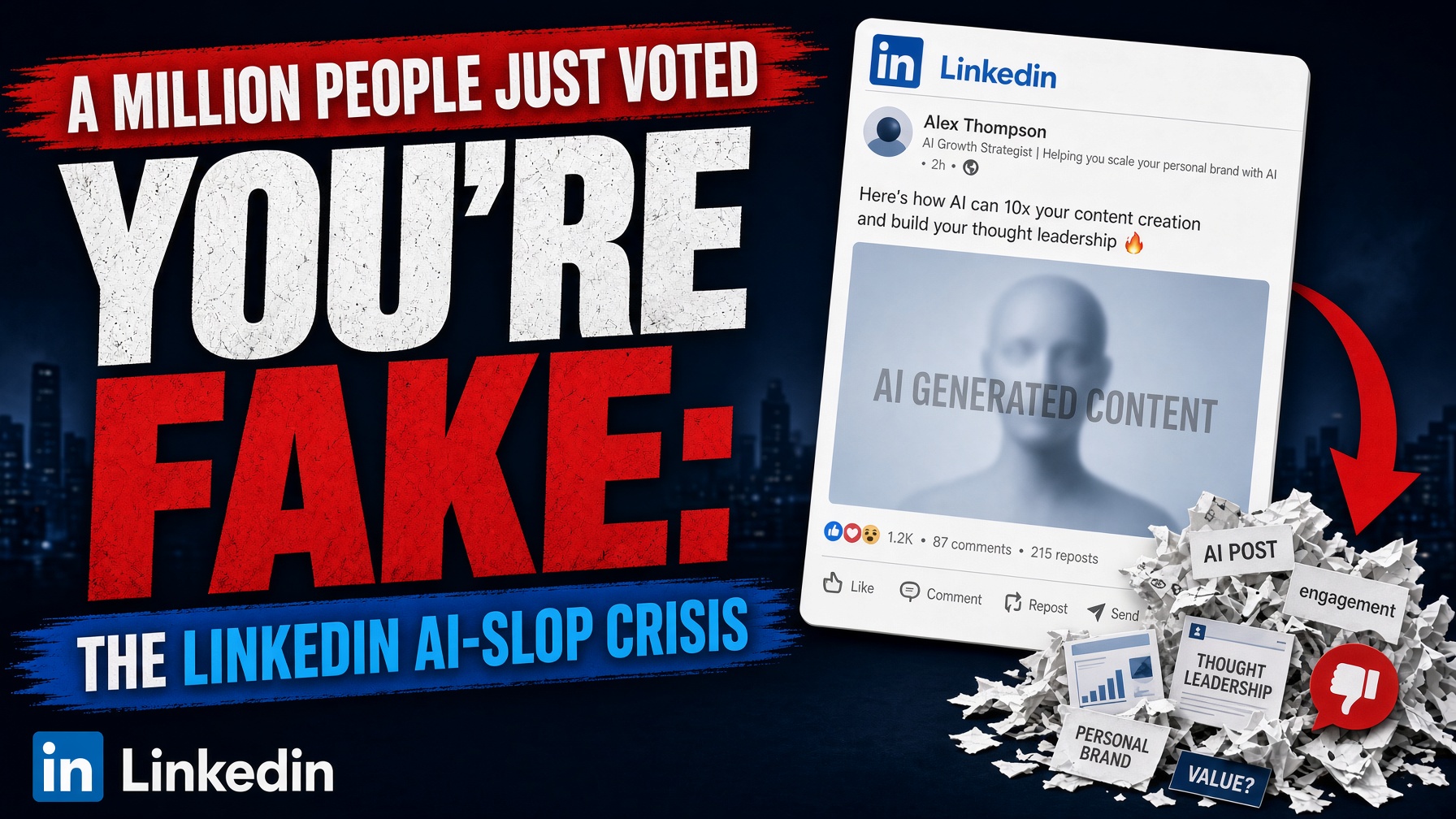
A million people just voted on who is fake. On the platform you post to every day.
In the two weeks after LinkedIn rolled out its "seems like AI slop" button, more than one million users clicked it. LinkedIn responded by cutting flagged posts' reach by roughly 40% in the feed. Underneath that number sits a bigger one: AI-detection research from Pangram found that LinkedIn is now the most AI-saturated platform measured, with more than 40% of long-form posts flagged as fully machine-generated.
Your feed is now close to half robot. And your audience is done pretending not to notice.
Let me tell you what I learned inside Burger King, long before any of this AI wave existed.
Everybody knew the slogan. Have It Your Way. Kids knew it. Grandparents knew it. But you could not run a single store unless you knew the brand bible cold.
A Whopper was not a sandwich. It was a specification. Four pickles. Not three. Not five. Four. Every store. Every shift. Every single time. The lettuce had a weight. The bun had a toast time measured in seconds. The brand was a promise, and the operation kept that promise, sandwich by sandwich, without exception.
Here is what most people never saw from outside. Burger King owned pieces of its own supply chain. The farms. The cattle relationships. The bakeries that made the buns. They did not simply buy a brand off a shelf. They manufactured it, from the ground up, every day.
A brand is not what you say it is. It is what they say it is. The customer has always held the pen, even when they had no easy way to prove it.
For 30 years, you could fake authenticity with a good slogan and a consistent color palette. Not anymore. Now your audience has a button. They are labeling you in real time, post by post — real or slop, human or filler — and the platform's own algorithm boosts the ones they trust and buries the ones they flag.
Most executives are speeding straight into that button without realizing it. They bought an AI writing tool. They set it to auto-post three times a day. They believe volume equals authority. Right now, volume is the exact thing that gets you flagged and buried.
The AI-slop backlash is not bad news for real operators. It is the best news fractional executives have gotten in years. For the first time since content marketing became a competitive sport, the platform itself is now actively punishing the generic and rewarding the specific.
Every post you publish is a Whopper. It either carries your promise, four pickles and all, or it breaks it with filler language a machine could have written for anyone in any industry. Say the thing only you have earned the right to say — the year, the company, the scar, the number. A model cannot fake a real memory. Your audience can feel the difference within one sentence, even if they cannot name why.
Own your supply chain the way Burger King owned its farms and bakeries. Your stories are the farm. Your 45 years of lived pattern recognition are the cattle. Nobody can scrape that from a public dataset, because it was never published anywhere for a model to find.
Here is the shift to make this week: stop shipping any content you would be embarrassed to defend, out loud, in a room full of peers. If a post could have been written about any executive in any industry, it is slop, whether a human or a machine typed it. If a post could only have been written by you, because it carries a detail nobody else lived, it survives the button.
What is LinkedIn's "seems like AI slop" button?
It is a feedback mechanism LinkedIn introduced that lets users flag posts they believe are fully AI-generated. Flagged posts see roughly 40% less reach in the feed.
How can I tell if my own content reads as AI slop?
Ask whether the post could have been written about any executive in your industry, with the names swapped out. If yes, it is generic, regardless of whether AI or a human wrote it.
Does this mean I should stop using AI tools entirely?
No. It means the raw output of an AI tool cannot be the final product. Your lived story, specific details, and personal judgment have to be the spine of the piece, with AI as a drafting aid at most.
This is exactly what M.A.D. — Maverick Advantage Design — and M.A.P. — the Maverick Advantage Platform — do together. M.A.D. builds a brand your audience trusts on sight. M.A.P. turns your real, lived experience into authority content, so the slop button never lands on you.
M.A.D. Designs Your Brand. M.A.P. Makes You Known For It.
Stop Reading. Start Seeing.