The black box is dead. M.A.D. — Maverick Advantage Design — rebuilds executive-search authority on brand archetypes and Myers-Briggs, transparent standards clients can read, paired with named consultants and published receipts.
The black box is dead. It just hasn’t stopped moving yet. The search firms that win the next decade will trade their proprietary jargon for a language their clients already speak — and charge more for the honesty.
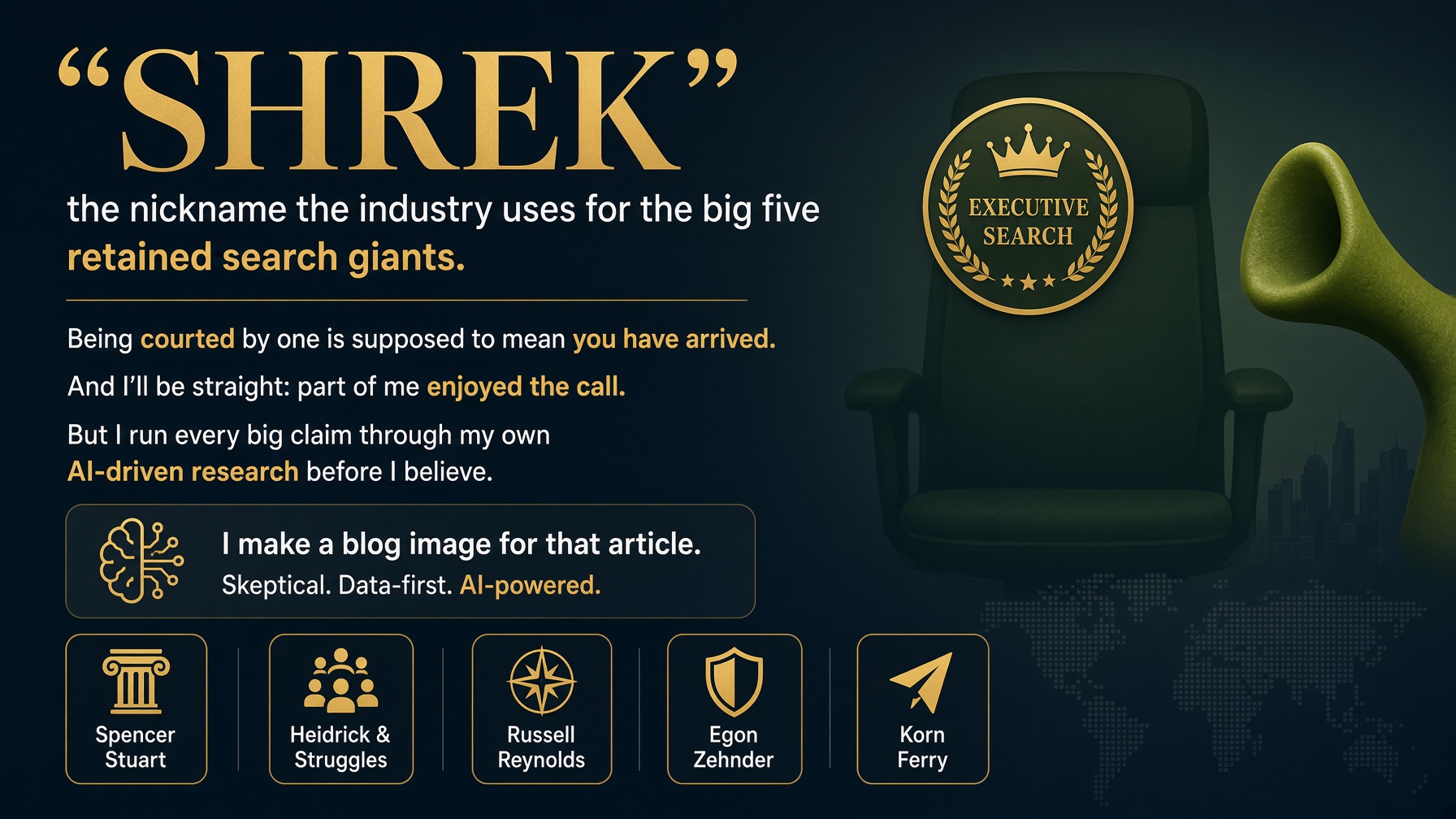
Last week Korn Ferry approached me. Instead of getting flattered, I ran my own AI research on how the big search firms actually perform. What I found wasn’t pretty: roughly 40% of retained searches never even produce a hire, and 40% to 50% of the executives who do get placed fail inside 18 months. The most expensive proprietary assessments in the business — Korn Ferry’s KF4D and its “SHREK”-firm cousins — hadn’t solved the problem. They’d just wrapped it in science.
I’ve seen this movie before. I saw what happened when the government broke up AT&T. I survived the International Harvester to Navistar collapse. At Navistar we built systems that predicted a $250,000 truck’s failure across 80 dealerships and called the owner before it broke down. That’s what real assessment looks like — proof that shows up before the failure does. The search industry sells the opposite: a confident score, and then a coin-flip on whether the person lasts a year.
So I built the alternative. It’s called M.A.D. — Maverick Advantage Design.
Here’s the market search firms are actually selling into now. Clients have been burned by seven-figure hires that walked in twelve months. AI has made it trivial for anyone — including the executive you’re assessing — to pull the industry failure data in an afternoon. And the whole edifice rests on proprietary frameworks that almost no one outside the firm can inspect. Two consulting models quietly define “high potential” for roughly a third of corporate America each, and they don’t even agree with each other.
When the tool is a black box and the results are a coin flip, “trust our proprietary science” stops working. That’s not a marketing problem you can rebrand your way out of. It’s a trust problem. And trust problems are only ever solved one way: transparency plus proof.
This is the exact fault line the ad agencies hit — proprietary opacity that worked right up until a sophisticated client asked to see inside. It’s the same pattern that took down confidence in the big consulting frameworks. Complexity that only the creator understands isn’t expertise. It’s a moat. And moats look impressive until the water drains and everyone can see the bottom.
The firms that survive won’t be the ones with the most impressive box. They’ll be the ones who make the assessment so clear that the client and the candidate can both read it, argue with it, and verify it. You don’t rebuild authority by guarding the jargon. You rebuild it by handing people a lens they already trust — and then standing behind the result with your name on it.
The window is open right now, and it closes the moment AI-driven scrutiny of search-firm outcomes goes mainstream — and it will. When that happens, every firm still hiding behind a proprietary score will look like it’s hiding something, because it is. The firms that move to a transparent framework in the next quarter get to call it leadership. The ones who wait will be doing damage control while a boutique with a clearer method eats their mandates. First quarter you build it. After that, you’re explaining the box.
M.A.D. — Maverick Advantage Design — does one radical thing: it throws out the private jargon and builds executive assessment on two lenses the whole market already understands. A brand archetype (who this leader is to the market — the Maverick, the Ruler, the Sage, the Hero) and a Myers-Briggs type (how they actually operate and make decisions). Two common standards. No secret decoder ring. Here’s how a firm operationalizes it.
1. Replace the black box with a shared language. Stop assessing executives against a proprietary profile only your team can interpret. Map them on frameworks a CEO already knows — archetype for market identity, Myers-Briggs for operating style. When the client can read the assessment without a translator, you’ve converted your biggest liability into your pitch.
2. Put your consultant stable out front as named authorities. Your credibility can’t live in a logo or a database anymore. It has to live in named practitioners with real reputations on the line. Build the personal brands of the consultants in your stable so a client is buying a person who can speak to their business — not an anonymous scorecard. Authority you can see beats authority you have to take on faith.
3. Assess on two transparent axes, not one hidden one. Archetype answers “who is this leader in the market’s eyes?” Myers-Briggs answers “how does this leader think, decide, and lead under pressure?” Together they give a client a fit picture they can actually reason about — instead of a proprietary number they have to swallow whole.
4. Match on fit the client can verify. Show the alignment in the open. Here is the archetype the role demands. Here is the candidate’s archetype and type. Here is where they line up and where they don’t. A client who can see the fit logic will trust the placement — and defend it internally when it matters.
5. Show the receipts on outcomes. Publish your real completion rate and your audited multi-year retention, not a cherry-picked promotion stat. The industry hides these numbers because they’re bad. Being the firm that shows them — even imperfect ones — is an authority move no proprietary framework can buy.
6. Own the 18-month danger zone. Most executive failures aren’t hiring failures — they’re onboarding failures. Build structured onboarding into the engagement so the archetype-and-type fit you sold actually survives contact with the org. The firms that cut failure rates to 10–15% do it here, not in the assessment.
7. Publish the standard and build the authority content around it. Put the M.A.D. method in the open — on your site, in your pitches, on LinkedIn. When you commit publicly to a transparent framework and let clients hold you to it, you stop competing on prestige and start competing on proof. That’s the authority the SHREK firms are quietly losing.
Let me be honest about what M.A.D. is and isn’t. It’s not a claim that archetypes and Myers-Briggs are more scientifically perfect than KF4D. It’s that they’re shared, readable, and honest — and paired with named expertise and published receipts, that combination rebuilds the one thing the black box destroyed: trust. A framework a client can read and argue with will always beat a score they have to take on faith, because the first one invites them in and the second one asks them to obey.
The question every executive and every client is now asking the search industry is simple: “Why should I trust your box?” The winning answer isn’t a better box. It’s: “I won’t ask you to. Here’s the framework, in plain language, with my name on the result and the retention data to back it.” Say that, mean it, and a trust crisis becomes the reason clients choose you.
Rebuilding a search firm’s authority on a transparent framework — M.A.D. mapping, a consultant stable with real personal brands, published outcome data, and onboarding that survives the first 18 months — is a first-quarter job, and it’s the exact work I do as a Fractional CDO. 90 days, four clients at a time. If you run a search firm losing ground to the black-box backlash, or you’re an executive tired of being reduced to someone’s proprietary score, book a consult and let’s design the advantage in the open.
Stop Reading. Start Seeing.
— Charles K Davis, Fractional CDO
P.S. This isn’t for firms that want to defend the jargon. It’s for the ones ready to hand clients a framework they can actually read and charge more for the honesty. If protecting the box matters more to you than the placement lasting, we’re not a fit. If that’s backwards to you, we should talk.