Tariff refunds went to importers, not shoppers. Charles maps the exposed cost layer to the Navistar call that reached the fleet manager before the truck broke down.
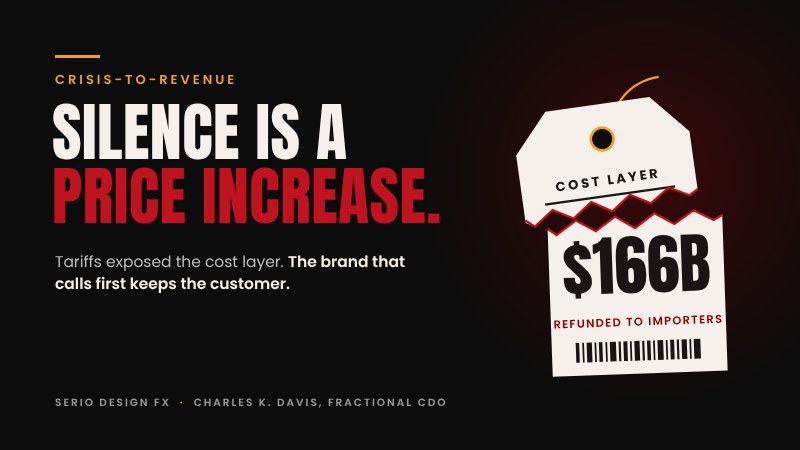
Your customers paid the tariff. Now they know it.
And they are watching to see what you do next.
In February 2026, the Supreme Court struck down most of the emergency tariffs. Refunds started flowing. But the money is going to companies, not to the shoppers who paid higher prices at the register. Every brand that raised prices now faces a choice. Stay quiet and hope nobody asks. Or pick up the phone first.
Most brands will stay quiet. That is the mistake that costs them the customer.
Tariff refunds are going to importers, not consumers, and customers are noticing.
On February 20, 2026, the Supreme Court ruled 6-3 that the International Emergency Economic Powers Act (IEEPA) does not give the President power to impose tariffs. (J.P. Morgan) The Court of International Trade then ordered the government to pay back an estimated $166 billion, plus interest, to around 330,000 importers. (Newsweek)
Here is the catch. The refund goes to the importer of record. There is no federal process that sends tariff money back to households. (24/7 Wall St.)
So shoppers paid the higher shelf prices. Companies get the check. Consumers have started suing individual companies to claim a share. (Newsweek)
A few brands moved first. Costco said it will use refunds to give members lower prices and better value. FedEx said it will return the money to the shippers and consumers who paid the charges. (24/7 Wall St.) Most brands said nothing.
The pressure is not over. 178 Section 301 tariff exclusions on Chinese goods run out on November 10, 2026. (USTR) And McKinsey found about 71% of fashion executives planned to raise prices in the year ahead. (Glossy)
Put that together. Right in the holiday buying season, your customer sees higher prices on your product and headlines about companies collecting billions in refunds.
This is round two. Round one came in April 2025, when factory videos flooded TikTok telling American shoppers they had overpaid for brands for years. (CNN) Many of those claims fell apart on inspection. (The Verge) It did not matter. The cost layer, the thing brands spent decades keeping out of sight, was on screen.
This time the numbers are in court records.
At Navistar, we called the customer before the truck broke down. That call was the brand.
I helped build systems at Navistar after International Harvester became Navistar. 800 dealerships across the country. Every truck in the database. Every repair. Every part. Every failure.
We tracked MTBF, mean time between failure, for every part of a $250,000 commercial truck. Engine. Transmission. Brakes. Cooling. Electrical. Real fleet data. Not vendor spec sheets.
Then we did the thing that made the system worth building.
We called the truck owner. Before the breakdown.
The fleet manager did not call Navistar. Navistar called the fleet manager. With the diagnosis. With the appointment booked at the nearest dealership. With the parts already pulled into the service bay.
Think about what that call did. The customer never had to wonder what was wrong. Never heard the bad news from a tow truck driver. Never had to guess whether we knew. We knew first. We said so first.
That call was not a service feature. It was the brand. It was why a fleet manager trusted us with the next truck, and the one after that.
When the cost layer gets exposed, the brand that explains first keeps the customer.
Your customer already knows prices went up. Your customer already read that refunds went to companies. Your silence does not protect your margin. It tells the customer that somebody else gets to tell the story. A factory video. A class-action lawyer. A Reddit thread.
Navistar did not wait for the truck to break. Most brands right now are waiting for the customer to break. To ask. To complain. To leave.
That is where the verdict splits.
Fatal for brands whose only story was the logo. If the price was the proof of value, and the price just got questioned in public, there is nothing underneath it.
Recoverable for brands whose value lives somewhere a factory cannot copy. Hermès made that point in 2025: its top bags are made in France, in-house, in a way that sets them apart. (NPR) A brand with a real answer to "why does this cost more" can take the hit and come out stronger.
Here is why most founders miss it. They treat pricing as a finance decision. It stopped being one. It is a trust decision now.
And you cannot make the call if you do not own the phone number. Navistar could call because Navistar owned the data across 800 dealerships. If a retailer, a marketplace or a wholesaler owns your customer, you find out about the problem after the customer is gone.
Make the call before the customer asks, and own the relationship that lets you make it.
Your window runs 90 days, from November 10, 2026, when the Section 301 exclusions lapse, through February 8, 2027. That covers the holiday season and the Q1 price resets. After that, someone else has written your story for you.
1. Run your own MTBF on trust. List your top five products. For each one, ask: if my cost of goods went viral tomorrow, what is my answer? Where you have no answer, that is your failure point. Fix those first.
2. Make the call before they ask. Publish a plain pricing note. What changed. Why. If you received a tariff refund, say what you are doing with it. Lower prices, better service, a loyalty credit. Pick one and say it out loud.
3. Own the phone number. Go direct to consumer wherever you can. Your own site. Your own email list. Your own community. Direct to consumer means you own the data, the conversation and the context when a price gets questioned.
4. Put a face on it. A factory video is a faceless claim. A founder who shows up, explains the decision and stands behind the product is much harder to undercut.
5. Show the proof. Process. Materials. Testing. Results. Proof beats a logo every time.
6. Line up the trinity. Three pieces have to tell the same story. The personal brand is the founder's voice. For me that is charleskdavis.org. The business brand is the promise and the method. That is Serio Design FX. The product showcase is the proof. For us that is Serio IQ. When all three line up, a price comparison cannot knock you over. When they drift apart, every crisis finds the gap.
Not from the government. Refunds go to the importer of record, the business that paid the duty at the border. Some companies, such as Costco and FedEx, have said they will pass value back to customers, and consumer lawsuits against individual companies are pending.
The cost layer is the gap between what a product costs to make and what it sells for. Brands used to keep it hidden. Factory videos in 2025 and tariff refund headlines in 2026 put it in front of customers.
Customers paid higher prices while the tariffs were in force. Now they see companies collecting refunds. A brand that says nothing looks like it kept the money, even if it absorbed most of the cost.
Say it first and say it plainly. Explain what changed, why the price moved and what the customer still gets for it. If you got a refund, say what you are doing with it.
When a middleman owns the customer, you cannot explain your value at the moment it gets questioned. Direct to consumer gives you the data and the channel to reach the customer before the doubt sets in.
178 product exclusions on Chinese imports lapse unless USTR extends them again. Brands that rely on those products face higher landed costs and fresh pricing decisions in the middle of holiday season.
The cost layer is not going back into hiding. The only question is whether your brand makes the call first.
The Free Revenue Audit shows you where your positioning is exposed and where revenue is leaking, so you fix it before a crisis does it for you.
M.A.D. (Maverick Advantage Design) builds a brand that holds up when the cost layer is exposed. M.A.P. (Maverick Advantage Platform) makes sure your customers hear your side first.
M.A.D. Designs Your Brand. M.A.P. Makes You Known For It.
Stop Reading. Start Seeing.
— Charles K. Davis, Fractional CDO