Your $50,000 competitive intelligence platform is showing you what already happened.
That's the problem most executives don't realize until they've lost a quarter. The tools tracking your competitors—Klue, Crayon, AlphaSense, the expensive ones your board approved—are all rearview mirrors. They tell you where competitors went. Not where the money is moving.
I spent 25 years inside Fortune 500 companies watching this pattern repeat. Illinois Bell during the AT&T breakup. International Harvester as it became Navistar. MCI as it collapsed into WorldCom. Every time, the executives with the best "competitive intelligence" were still 90 days behind the executives who could see patterns forming.
The difference between tracking competitors and detecting opportunity is the difference between reading yesterday's newspaper and writing tomorrow's headline.
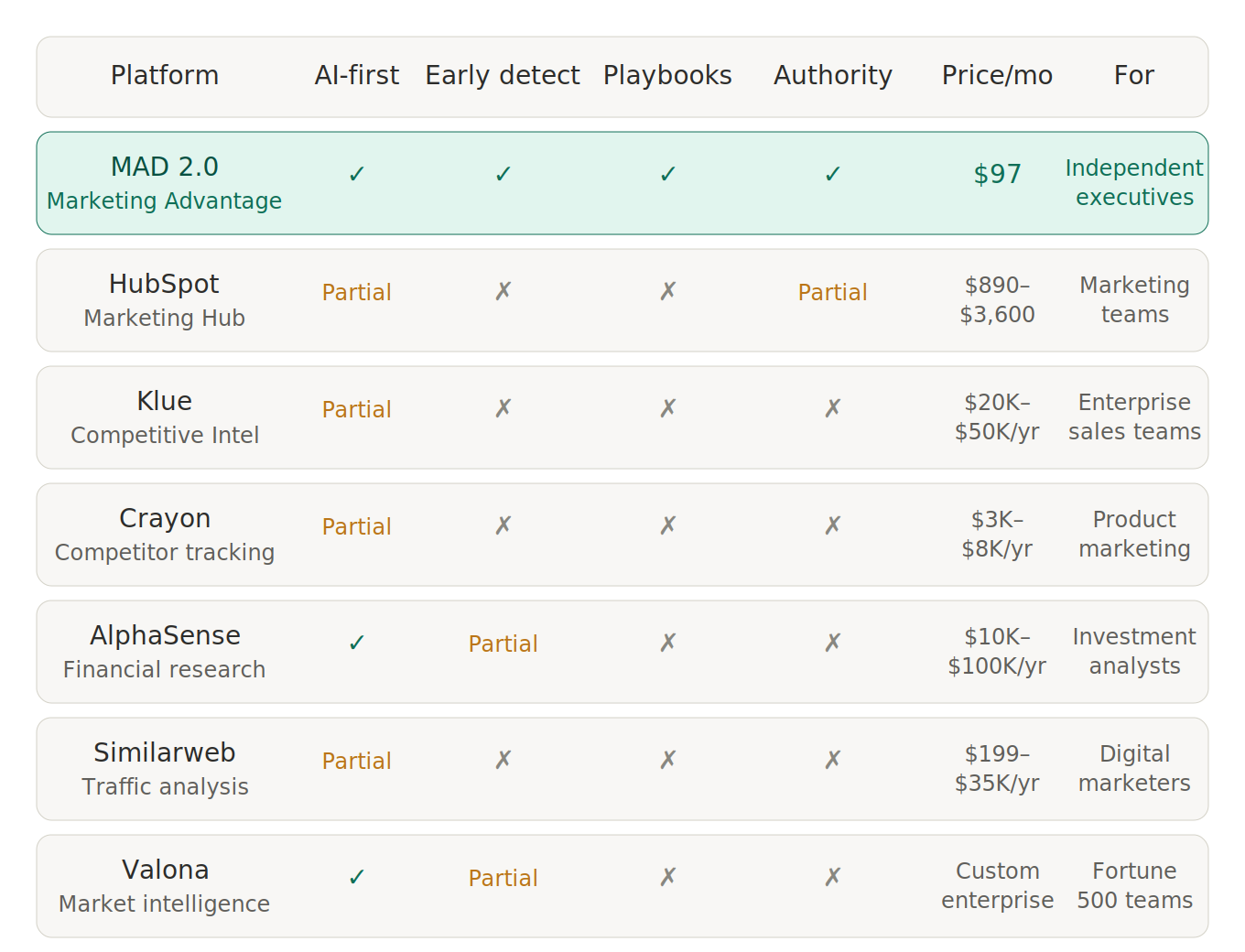
This guide compares the top strategic marketing intelligence platforms for 2026—what they actually deliver, what they cost, and whether they help you see what's coming or just document what already passed.
By Charles K Davis | Updated March 21, 2026
Your $50,000 competitive intelligence platform is showing you what already happened.
That's the problem most executives don't realize until they've lost a quarter. The tools tracking your competitors—Klue, Crayon, AlphaSense, the expensive ones your board approved—are all rearview mirrors. They tell you where competitors went. Not where the money is moving.
I spent 25 years inside Fortune 500 companies watching this pattern repeat. Illinois Bell during the AT&T breakup. International Harvester as it became Navistar. MCI as it collapsed into WorldCom. Every time, the executives with the best "competitive intelligence" were still 90 days behind the executives who could see patterns forming.
The difference between tracking competitors and detecting opportunity is the difference between reading yesterday's newspaper and writing tomorrow's headline.
This guide compares the top strategic marketing intelligence platforms for 2026—what they actually deliver, what they cost, and whether they help you see what's coming or just document what already passed.
Before comparing platforms, you need to understand the three requirements that separate useful intelligence from expensive documentation:
1. Early Detection (The 30-Day Rule)
Implementation takes time. Any initiative worth doing requires roughly 30 days to execute properly. A competitive intelligence tool that alerts you to a market shift after your competitors have already moved gives you documentation, not advantage.
The question isn't "Did you know?" It's "Did you know first?"
2. Rapid Strategic Synthesis
Raw data creates paralysis. Most intelligence platforms dump information on your desk and call it "insights." What executives actually need is a path from signal to strategy—visual roadmaps, 90-day playbooks, frameworks that compress analysis into action.
Your CEO doesn't read 47-tab research decks. They scan one visual that shows what's happening, why it matters, and what to do.
3. Integrated Execution with Authority Building
Knowing something gives you no advantage if you can't act on it and protect the position you create. Sustained competitive advantage requires execution support—content that establishes authority, lead generation that captures opportunity, and continuous monitoring that protects your gains.
Most platforms handle one or two of these requirements. Almost none handle all three.
Rating: 5.0/5
Why it made our list: MAD 2.0 is the only platform built specifically for independent executives who need to see where money is moving before competitors notice. It's not a competitive tracking tool—it's strategic revenue intelligence that combines disruption scanning, advisory frameworks, and automated authority building in one system.
While enterprise tools like Klue and Crayon excel at tracking what competitors did, MAD 2.0 focuses on identifying what executives should do next. The platform's Shadow Advisory Board applies frameworks from proven strategists—Peter Thiel's contrarian positioning, Naval Ravikant's leverage principles, Warren Buffett's value identification, Y Combinator's growth frameworks—to generate visual roadmaps and 90-day playbooks for each disruption it detects.
Key features:
Pricing: $97/month (founding member rate; standard rate $197/month after first 100 members)
Best for: Executives 40+ with Fortune 500 experience who left corporate environments and now need strategic independence. Founders and fractional leaders who can't afford enterprise intelligence pricing but can't afford to miss opportunities either.
The bottom line: MAD 2.0 addresses the gap that even $50K/year enterprise platforms don't fill—forward-looking opportunity detection combined with immediate execution support. At $97/month versus $20K–$100K/year for enterprise alternatives, the economics make it accessible to independent executives who've been priced out of serious strategic intelligence.
Rating: 4.5/5
Why it made our list: HubSpot remains the gold standard for marketing automation and CRM operations. Its Breeze AI tools add intelligence capabilities to an already comprehensive platform. But intelligence isn't the primary function—operational efficiency is.
HubSpot excels at what happens after you've identified an opportunity: email sequences, lead nurturing, content distribution, sales pipeline management. It's the execution engine, not the strategic radar.
Key features:
Pricing:
Best for: Marketing teams at established companies that need to automate and scale operations within their existing pipeline. Teams that already know their market position and need execution power.
The bottom line: HubSpot is the place you go once you've found the opportunity. It doesn't find opportunities for you—it helps you capitalize on them at scale. Pairing HubSpot's operational power with a strategic foresight tool like MAD 2.0 covers both ends of the intelligence-to-execution spectrum.
Rating: 4.3/5
Why it made our list: Klue pioneered the competitive intelligence battlecard. If your sales team needs real-time talking points about what competitors are doing—pricing changes, feature launches, messaging shifts—Klue delivers that faster than manual research ever could.
The platform integrates with Salesforce, Slack, and HubSpot to surface competitive intelligence directly in seller workflows. Its AI now auto-generates insights from CRM data, sales calls, and web monitoring.
Key features:
Pricing: Enterprise pricing (contact for quote). Market data suggests $20K–$50K+/year for typical enterprise deployments, with per-seat models available.
Best for: B2B sales organizations with dedicated competitive intelligence teams. Companies with 3+ direct competitors and deal cycles long enough to benefit from battlecard-style intelligence.
The bottom line: Klue is excellent at what it does—enabling sellers to compete on deals already in progress. It's a rearview mirror, polished to perfection. It won't tell you which market to enter or which disruption to capitalize on. It tells you how to win the deal you're already fighting for.
Rating: 4.2/5
Why it made our list: Crayon tracks competitor moves across the digital landscape and turns them into actionable sales enablement. It monitors websites, social media, news, and reviews, using AI to surface what matters and filter what doesn't.
The platform particularly excels at keeping battlecards current without manual maintenance—a significant time savings for competitive intelligence teams that previously spent 80% of their time on upkeep.
Key features:
Pricing: Custom quotes based on scope. Market data indicates $3,000–$8,000+/year for typical deployments, with enterprise pricing significantly higher.
Best for: Product marketing teams responsible for competitive positioning. Companies in fast-moving markets where competitor messaging and features change frequently.
The bottom line: Crayon reduces the manual labor of competitive tracking from weeks to minutes. But like Klue, it's reactive intelligence—telling you what competitors just did, not where the market is heading. Good for defense. Less useful for strategic offense.
Rating: 4.4/5
Why it made our list: AlphaSense is the heavyweight for financial and market research. It aggregates SEC filings, earnings transcripts, broker research, expert interviews, and news into a searchable intelligence platform powered by strong AI search and summarization.
Investment analysts, corporate strategists, and M&A teams use AlphaSense to answer complex research questions in minutes instead of days. The platform's Expert Transcript Library (expanded through its $930M Tegus acquisition) provides access to off-the-record insights from industry insiders.
Key features:
Pricing: Enterprise-only, custom quoted. Market data indicates $10,000–$100,000+/year depending on seat count and premium content access. Per-seat pricing typically $10,000–$20,000/year.
Best for: Investment professionals, corporate development teams, and strategy analysts at large organizations who need deep research capabilities across financial data sources.
The bottom line: AlphaSense is research-oriented intelligence for people paid to know everything about a company or market. It's exceptional at that job. But it's not designed for independent executives or founders who need forward-looking opportunity detection at an accessible price point.
Rating: 4.1/5
Why it made our list: Similarweb tracks website traffic, referral sources, audience demographics, and digital market share across millions of sites and apps. If you need to know how much traffic competitors get, where it comes from, and how it trends over time, Similarweb delivers that data.
The platform's competitive intelligence capabilities help marketers benchmark performance, identify successful channels, and understand audience overlap. Its AI agents and new data tools extend functionality into SEO, keyword analysis, and sales prospecting.
Key features:
Pricing:
Best for: Digital marketers and SEO professionals who need traffic data for competitive analysis. E-commerce companies tracking category trends. Agencies benchmarking client performance.
The bottom line: Similarweb excels at descriptive analytics—what's happening now and what happened before. It doesn't predict where digital behavior is heading or connect traffic patterns to revenue opportunities. Valuable data, but not strategic foresight.
Rating: 4.3/5
Why it made our list: Valona (formerly M-Brain) is a Forrester Wave Leader in competitive and market intelligence platforms. It combines AI-powered monitoring across 200,000+ global sources with human analyst support to deliver intelligence that large enterprises can trust.
The platform's strength is comprehensive coverage—monitoring news, patents, trade publications, financial data, and regulatory changes across 100+ languages. Its AI summarizes findings into digestible formats, while human analysts validate and contextualize.
Key features:
Pricing: Custom enterprise pricing. No public pricing available; contact for tailored packages.
Best for: Large enterprises (Fortune 500, major multinationals) with dedicated competitive intelligence functions. Organizations with complex global monitoring needs spanning multiple regions, languages, and regulatory environments.
The bottom line: Valona is the enterprise-grade solution for organizations that can afford dedicated intelligence infrastructure. It's not designed for independent executives or SMBs. The "contact us for pricing" model signals enterprise budgets, enterprise complexity, and enterprise implementation timelines.
Here's what none of these platforms—even the best of them—are designed to do:
They don't tell you where to look.
Klue and Crayon track competitors you've already identified. AlphaSense searches documents about companies you already care about. Similarweb analyzes sites you're already watching. Valona monitors markets you've already defined.
But the biggest opportunities don't come from incremental improvements within your existing view. They come from spotting disruptions before your competitors even know to look.
When International Harvester became Navistar, the executives watching IH's direct competitors missed the real threat—the market structure was collapsing, not shifting. When AT&T broke apart, the executives tracking each Baby Bell missed the revenue implications for telecommunications infrastructure. When Y2K hit, the executives focused on "competitive intelligence" missed the pattern recognition that made certain infrastructure plays obvious.
Pattern recognition isn't competitive tracking. It's different neural infrastructure entirely.
Choose MAD 2.0 if:
Choose HubSpot if:
Choose Klue or Crayon if:
Choose AlphaSense if:
Choose Similarweb if:
Choose Valona if:
The strategic intelligence market has an ironic gap: the platforms serving executives cost more than most independent executives can afford, while the platforms independent executives can afford don't actually provide strategic intelligence.
Enterprise tools like Klue, Crayon, AlphaSense, and Valona deliver genuine value—but at $20K–$100K+/year, that value is accessible only to large organizations with dedicated intelligence functions.
HubSpot and Similarweb deliver strong operational and analytical capabilities at more accessible price points—but they're not designed for forward-looking strategic foresight.
MAD 2.0 fills this gap by combining early opportunity detection, strategic synthesis, and execution support at a price point ($97/month) that independent executives, founders, and fractional leaders can actually afford.
The question isn't which platform is "best." The question is which platform matches your situation:
Stop reading. Start seeing.
Take the Revenue Intelligence Assessment to identify where money is hiding in your market: [Link to Assessment]
P.S. — This analysis isn't for executives who want comfortable validation. It's for leaders who survived corporate environments and know the difference between "competitive intelligence" that documents history and strategic foresight that creates it. If that's not you, these platforms will all feel roughly the same. If that is you, the distinction is everything.
