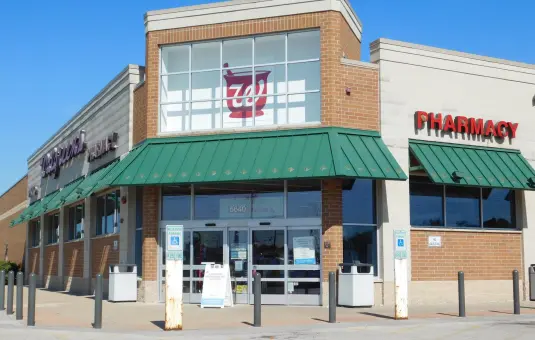
When my family first moved to Chatham, there was no Walgreens.
There was no CVS. No Jewel-Osco on every corner. The pharmacies were owned by people who lived in the neighborhood. The stores were owned by people you saw at church on Sunday. Cottage Grove Avenue was a working street run by working people. Black-owned. Black-built. Black-operated.
Then Afro-American families moved out of Bronzeville in greater numbers. The South Side population grew. The demand for services became obvious. The big brands saw the demand and they came in. They opened stores on the corners where local pharmacies used to stand. They put up their signs. They took the rent. They took the customers.
Now they're leaving.
The Walgreens at 8628 S. Cottage Grove Avenue closes June 4, 2026. The specialty pharmacy at 2351 E. 71st Street in South Shore closes May 19, 2026. Five other South and West Side Walgreens have already closed in the last year — Bronzeville, Little Village, South Shore, Chicago Lawn, South Chicago.
The press calls this a pharmacy desert. The Alderman calls it corporate abandonment. The protests on May 4 used the word "abandonment" again and again.
I want to say something different.
You cannot abandon a place that was never yours.
The story being told in the news right now goes like this: Walgreens served the neighborhood, Walgreens is leaving, the neighborhood is now a desert.
That story skips the first chapter.
The first chapter is local ownership. Black-owned pharmacies. Black-owned grocers. Black-owned everything you needed to live. That chapter existed in Chatham. It existed in Bronzeville before it. It existed in every Black neighborhood in Chicago before brand consolidation rolled through in the 1970s and 1980s.
The second chapter is what the brands did. They used capital to underprice local owners. They used scale to outlast them. They used national contracts with pharmacy benefit managers to lock up prescriptions. The locally owned pharmacy could not compete on price for a 90-day generic refill. The locally owned grocer could not compete on volume for cereal and milk. One by one, local owners closed. The brands took the corner. The brands took the rent. The brands took the customer relationship.
The third chapter is now. The brands have decided the corner is no longer profitable. So they leave.
When you only tell chapter two and chapter three, it sounds like loss. When you tell chapter one, chapter two, and chapter three, it sounds like extraction.
A 40-year extraction cycle is not abandonment. It is the business model finishing.
Walgreens cites theft. Walgreens cites violent incidents. Walgreens cites safety challenges. The company was acquired by Sycamore Partners in 2025. Sycamore is a private equity firm. Their stated plan is to close up to 1,200 stores nationally by 2027.
Read that sentence one more time. The decision to close 1,200 stores was made before any individual neighborhood's "safety" was assessed. The portfolio review was done at the private equity level. The stores in Chatham, in South Shore, in Bronzeville — they were already on the closure list. The "safety" language was the press release.
Private equity does not abandon neighborhoods. Private equity optimizes returns. The neighborhoods that get cut are the neighborhoods where the spread between rent, theft loss, and pharmacy reimbursement no longer hits the target. That is the entire calculation.
I saw what happened when the government broke up AT&T. The Bell System operated under a regulated public-utility framework. Service to all neighborhoods was a condition of the franchise. When the breakup came, that condition came off. Service tiers emerged. Profitable customers got fiber. Unprofitable customers got copper, then nothing. The infrastructure that everyone paid for through decades of regulated rates got reallocated to the customers who paid the most going forward.
The pharmacy retail model is running the same play. The cross-subsidy that kept lower-volume stores viable inside a national chain is gone. Each store has to earn its own return. The South Side stores no longer do. So the South Side stores close.
This is not safety. This is portfolio math.
The brands were never the foundation. They were the middle chapter.
For about forty years, big-box pharmacy and big-box grocery extracted prescription revenue, food revenue, household-goods revenue, and customer data out of South Side neighborhoods. They sent the profits to corporate headquarters. They paid local property taxes and local wages, yes — that was the trade. But the wealth-building part of the equation, the ownership part, the equity part — that stayed at the top.
Now the model is failing on its own terms. Reimbursements are tighter. Theft is higher. Operating costs are up. Private equity wants the margin or it wants out.
What's leaving was never the foundation of Chatham. The foundation was already there before they arrived. The foundation is still there.
The foundation is the people, the churches, the trade skills, the families, the buying power, and the buildings. The buildings, in particular. The Walgreens at 8628 S. Cottage Grove is a leased commercial space. When the lease terminates, the space comes back into circulation. The pharmacy fixtures, the cooler units, the prescription counter — all of it can be acquired or rebuilt at a fraction of new construction cost.
The closing Walgreens is not the end of pharmacy access in Chatham. It is the end of an extraction lease.
What replaces it is the question.
When private equity closes a corridor of stores, the leases do not stay on the market forever. National operators move first. Dollar General. Family Dollar. Discount tobacco. Cell phone resellers. Bail bond storefronts. Within twelve to eighteen months, the corner gets re-leased to whoever makes the next-lowest bid for the same square footage.
The window for a different outcome is narrow. I estimate it at 90 days from the date of closure, though that varies by lease structure and landlord.
In that 90-day window, three things are possible that are not possible afterward:
After 90 days, the lease is gone. The next operator is in. The neighborhood gets another twenty-year extraction cycle from a different brand.
Critics will say a neighborhood-owned pharmacy cannot compete with a chain. They said the same thing about credit unions when banks consolidated. Today, credit unions hold over $2 trillion in assets in the United States and serve more than 130 million members.
They said the same thing about food co-ops. Today, the Park Slope Food Coop in Brooklyn does over $50 million a year in sales with a 17,000-member working membership and is one of the most profitable grocery operations per square foot in New York City.
They said the same thing about REI. REI is structured as a cooperative. REI did $3.5 billion in revenue last year.
The cooperative model works. The model has worked for a hundred and fifty years. What stops it from working in Chatham is not economics. What stops it is the assumption that the neighborhood needs a brand to give it permission to own its own infrastructure.
The neighborhood does not need permission.
For a co-op pharmacy to take the Walgreens lease at 8628 S. Cottage Grove, the steps are not mysterious:
This is not theory. This is procedure. The capital exists. The legal structure exists. The market exists.
What is missing is the decision.
If you are an executive, an entrepreneur, a community development financier, or a private capital allocator looking at the Milwaukee–Chicago corridor, you are watching one of the largest commercial-real-estate redistributions in Midwest urban history happen in real time.
The closures create three categories of opportunity:
Category 1: Cooperative anchor tenancy. Equity participation in neighborhood-owned pharmacy and grocery co-ops. Lower margin than private equity returns but lower risk and longer hold.
Category 2: Mixed-use redevelopment. The Walgreens footprint is roughly 14,000 square feet. The structure can be reconfigured for clinic + pharmacy + community kitchen. Federally Qualified Health Centers (FQHCs) need square footage in exactly these neighborhoods.
Category 3: Advisory and operational support. Most cooperative boards are first-time operators. They need fractional executive support — finance, marketing, digital, operations. This is where my work as a Fractional CDO intersects directly with the model.
The window is 90 days from each closure. June 4. June 23. May 19. After that, the corridor gets re-leased and the cycle starts again.
What is a pharmacy desert?
A pharmacy desert is a neighborhood where residents do not have reasonable access to a licensed pharmacy. The U.S. standard is more than one mile from the nearest pharmacy in an urban area, more than ten miles in a rural area. Chicago's South Side, particularly Chatham, Bronzeville, South Shore, and South Chicago, meets the urban definition.
Why is Walgreens closing stores on Chicago's South Side?
Walgreens cites theft, safety, and operational unprofitability. The company is owned by Sycamore Partners as of 2025 and is executing a national plan to close up to 1,200 stores by 2027. The South Side closures are part of that broader plan, not isolated decisions.
Can a community cooperative replace a closed Walgreens?
Yes. Cooperative pharmacies and cooperative grocers operate successfully throughout the United States. The legal structure exists under state cooperative statutes. The capital is available through CDFI partners and HRSA grants. The wholesale supply is available through pharmacy purchasing cooperatives.
What is the timeline to act?
Approximately 90 days from each store closure. After that, the lease is typically re-let to the next national operator (commonly Dollar General, Family Dollar, or similar). The window narrows quickly.
Where can I learn more about the cooperative model?
The National Cooperative Business Association (NCBA CLUSA) maintains resources for new cooperatives. The Illinois cooperative statute is 805 ILCS 315. CDFI partners in Chicago include Chicago Community Loan Fund and IFF.
I work with executives and community leaders building infrastructure that takes neighborhoods back from extraction.
If you are a board member, an organizer, a developer, or a capital allocator looking at the South Side opportunity, my Fractional CDO engagement helps you build the digital and operational systems a community-owned operation needs to compete. M.A.P. (the Maverick Advantage Platform) is the content engine that builds your authority on LinkedIn while you do the real work on the corner.
The Walgreens closes on June 4. The corner becomes available. The decision is whose name goes on the lease next.
Visit seriodesignfx.com or book a 90-day consult.
Stop Reading. Start Seeing.
— Charles K. Davis
