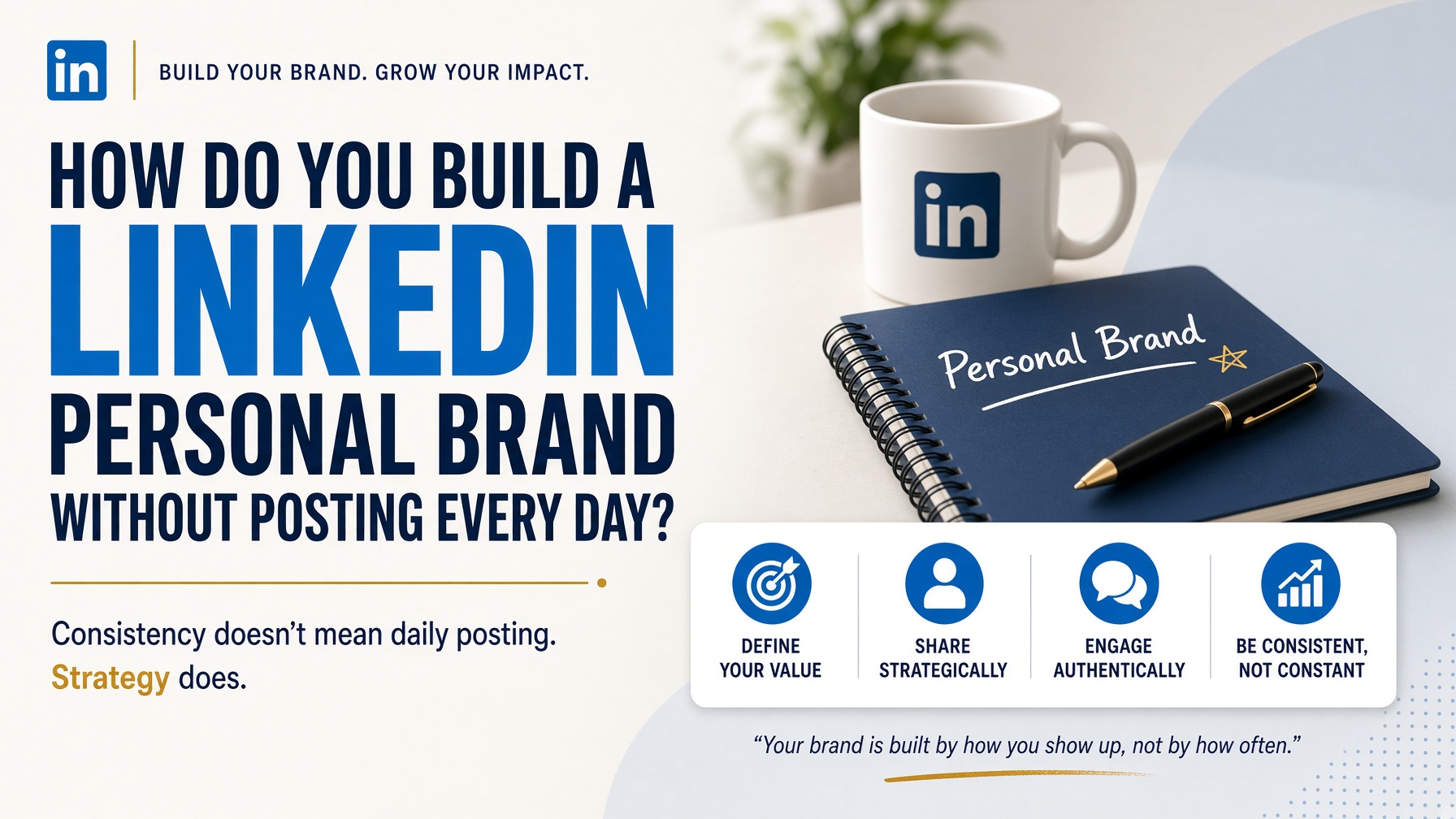
Posting more won't build your LinkedIn brand.
Most founders I talk to don't have a content problem. They have a reputation problem, and someone told them it was a content problem.
So they post every day. They copy the hook formula from the course they bought. They show up on LinkedIn, X, YouTube and a podcast they barely have time to prep for. Six weeks in, they're tired. Reach is flat. The post they're proudest of got fourteen likes, and eleven came from people trying to sell them something.
I read founder threads on Reddit to find out what people really struggle with, not what the gurus say they struggle with. The same complaints come up again and again:
All of it is fair. Almost none of it gets fixed by posting more.
Your reputation walks into the room before you do. I learned that long before LinkedIn existed.
I spent 25 years inside the Fortune 500, at companies like AT&T, International Harvester and Navistar, MCI/WorldCom, McDonald's, Motorola and Commonwealth Edison. Then I spent 20 more years building my own businesses. In all that time, one pattern kept repeating.
The big decisions were made before the meeting started.
A VP had already asked around about you. A board member had already called a peer: "Do you know this person?" Procurement had already pulled up your profile on a second monitor. By the time you started your pitch, the room had already made up its mind. Your reputation had spoken for you, for better or worse.
That hasn't changed. What has changed is who does the checking.
More and more, it's a machine. An AI search assistant sums up who you are. A feed decides whether your post reaches the people you want to reach. Reputation still enters the room before you do. It just passes through a machine on the way.
No. Organic reach on LinkedIn is harder, but it isn't gone. It's handed out on different terms.
You're not imagining the drop. Plenty of founders now assume LinkedIn is pay-to-play. My read is different.
LinkedIn has published research on a model called 360Brew. It's a large language model for ranking and recommendations that reads profiles and posts as text. Some commentators blew that up into "360Brew now ranks every post you write." LinkedIn has pushed back on that. It isn't simply the system that runs the feed, and I won't claim to know exactly what runs the feed today.
Here's what I can say. The direction is clear. LLM-style ranking and AI search reward the same few signals:
Keyword stuffing doesn't make that list. Neither do recycled hooks or "ten tips for founders" carousels.
Because these systems don't reward volume. They reward being clearly and consistently someone.
That's the brutal truth. Fourteen posts about fourteen topics don't make you known. They make you noise. The decision-makers in those old boardrooms never asked, "How often does this person talk?" They asked, "What is this person known for?" The machines ask the same question now.
That's good news if you're tired. You don't need more output. You need a clearer signal.
Start with the page every reader and every AI system checks first. Every post you publish either adds to that page or drifts away from it.
Twice a week is enough, if both posts are worth reading and both sit in the same lane. Here's the rhythm I give founders who are burned out on daily posting.
Monday: the crisis anchor. Take a real problem your market is facing right now. A supply shock. A funding freeze. A new regulation. A competitor's public mess. Walk through how a leader should handle it. I call these Crisis-to-Revenue playbooks: what happened, what it costs if you ignore it, and the move that turns it into an advantage.
Wednesday: the archetype post. This is your philosophy. The belief you'd defend in a boardroom. A pattern you've seen across twenty companies. A mistake you made so others don't have to.
That's it. Two posts. Maybe two focused hours a week. The rest of your time goes back to the business.
This also solves being everywhere. Pick the platform where your buyers make decisions. For most B2B founders, that's LinkedIn. Build a native library there: posts and articles people can read without being sent somewhere else. Constant links off the platform train readers and ranking systems to scroll past you. Cross-post later if you want. Just have one home base.
Stop typing your first drafts. Say them out loud.
Record a voice memo or a five-minute video. Answer one question: "What happened this week that most people in my industry got wrong?" Transcribe it. Cut the filler. Use your own spoken words as the body of the post.
Spoken words carry rhythm, opinion and detail that blank-page writing smooths out. They sound like a person because they came from one. They don't read like the AI sludge that readers, and more and more the ranking systems, have learned to skip.
Then add receipts. The dollar figure. The number of plants. The month the contract nearly fell through. The thing your CFO said.
That's the difference between fake polish and real reputation. Polish is how a post looks. Reputation is proof you were there.
This also helps with fear of posting in public. You're not performing as a thought leader. You're reporting what you've seen and what you'd do about it. Nobody can tell you your own experience is wrong.
Your reach doesn't only come from your posts. It also comes from showing up, with substance, in the conversations your buyers already follow.
Pick five to ten people your audience trusts: analysts, operators, respected founders in your space. Turn on post notifications for them. When they post, be one of the first useful voices in the comments.
Make it a 3D comment:
"Great post!" adds nothing. A 3D comment is a small post of its own, in front of an audience someone else already built.
Every founder hits the week with nothing to say. In every Reddit thread on personal branding, someone admits they quit right there.
Motivation doesn't hold up. A system does. That's why we built Serio IQ.
Serio IQ watches a live X stream for your market, filters out the noise, and gives you a three-part canvas:
Then you write the post. Better yet, you speak it. You post it yourself. Serio IQ doesn't ghostwrite your voice or post for you. It makes sure you never open LinkedIn on a Monday morning without your crisis anchor, and it keeps every post in the lane your profile has claimed.
It's built for founders who are, fairly, tired of growth advice. No hook library. No "post three times a day" rule. No funnel dressed up as a strategy. Just a way to turn market noise into authority content that belongs to you.
If you want to see why generic tools fall short, read why AI LinkedIn tools all sound the same and the difference between LinkedIn scheduling and authority.
Yes. Two strong posts a week in one clear lane build more authority than daily posts on scattered topics. AI-driven ranking rewards clear topical authority and lived experience, not volume.
Twice is enough for most B2B founders. Post a crisis anchor on Monday that walks through a real market problem, and an archetype post on Wednesday that shares your philosophy.
360Brew is a large language model LinkedIn has published research on for ranking and recommendations. It reads profiles and posts as text. LinkedIn has said it isn't simply the system that runs the feed, so treat claims that it "ranks every post" with care.
No. It's harder, and it goes to different signals. Clear topical authority, a profile that matches your posts, lived experience and native content people spend time on all help. Keyword stuffing and recycled hooks don't.
Speak your first draft. Record a short voice memo or video, transcribe it, cut the filler, and add receipts: real numbers, dates and moments only you could know.
Your headline. Name who you help and what changes for them, then keep it for at least two years. After that, use one consistent name everywhere, put one useful resource in Featured, and write your About section for buyers.
If you take one thing from this: stop trying to be everywhere every day, and become unmistakable somewhere twice a week.
Fix the profile. Claim the lane. Post the Monday anchor and the Wednesday archetype. Say it out loud before you write it. Comment like a peer.
Want to know where your reputation stands today? Start with a free LinkedIn Reputation Audit at seriodesignfx.com/audit. No card required. We'll show you how your profile reads to decision-makers and to the AI systems that now screen for them, and what to fix first.
When you're ready to stop guessing what to post, Serio IQ turns live market signal into the three-part authority canvas, so your reputation is in the room before you are.
Charles K Davis is a Fractional CDO for B2B founders and manufacturers and the founder of SERIO Design FX, home of M.A.D. (Maverick Advantage Design) and M.A.P. (Maverick Advantage Platform). He spent 25 years inside the Fortune 500 and 20 more building his own businesses. He works from Cebu, Philippines, with clients in the US, Australia and Singapore.
M.A.D. Designs Your Brand. M.A.P. Makes You Known For It.
Stop Reading. Start Seeing.
