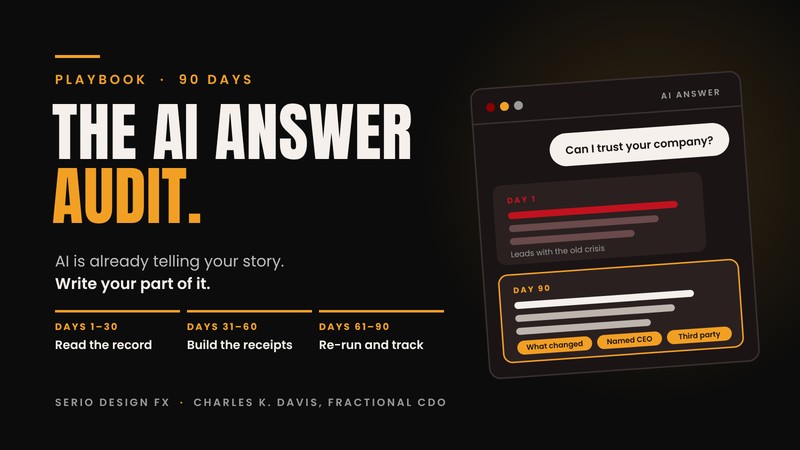
A 90-day build to audit what ChatGPT, Gemini, Perplexity and Copilot say about a brand, create the receipts-based record AI systems cite, and sell AI reputation monitoring as a recurring service.
AI is already telling your story. The only question is whether you wrote any of it.
This playbook is the build. Ninety days to find out what AI says about a company, fix the record it pulls from, and turn that work into a monthly service. Use it on your own brand. Or sell it to the companies that are about to learn this the hard way.
Why start with WorldCom?
Because a story with no counter-record wins forever.
I was a QA consultant on MCI/WorldCom work while the collapse was building. People got stock options instead of pay raises while the fraud grew at the top. When it surfaced in 2002, it came to about $11 billion. The business went on under the MCI name and was later bought by Verizon. But nobody built a new record. Today, AI still leads with the fraud.
The lesson is not "avoid scandals." The lesson is that silence after a crisis is a decision. It hands your story to whoever wrote the loudest version.
Days 1 to 30: What does AI say about you right now?
You cannot fix a record you have never read.
- Write the question set. Twelve to twenty questions a real person would ask. "Is [company] a good place to work?" "Can I trust [company]?" "What happened at [company]?" "Who is [CEO name]?" Add questions about your recent layoffs if you had them.
- Run every question in four tools. ChatGPT, Google Gemini and AI Overviews, Perplexity and Microsoft Copilot. Save every answer with the date.
- List every source they cite. Perplexity and AI Overviews show links. Put each one in a sheet. Mark it positive, neutral, negative or wrong.
- Score the gap. For each negative item, ask one question. Is there a public, credible source that tells what happened next? If not, that is a hole.
- Separate wrong from true. Wrong facts get a correction request to the source. True but old stories get a counter-record. Do not mix them up.
At day 30, leadership sees a one-page map: what buyers and candidates are told, where it comes from, and which holes matter most.
Days 31 to 60: How do you build the counter-record?
AI trusts receipts, so give it receipts.
- Write the "what changed" page. One clear page on your own site for each major old crisis. What happened, what you fixed, when, and who owns it now. Dates. Names. Numbers you can prove.
- Answer the questions directly. Use the exact questions from your audit as headings. Put a short, plain answer right under each. This is the format AI systems quote.
- Put leaders on the record. Named executives publish on LinkedIn about what changed and why. One clear voice beats ten anonymous press releases.
- Earn third-party proof. Customer stories, partner quotes, industry interviews and podcast appearances. AI weights sources it trusts more than your own site.
- Fix the layoff story now. If you cut staff this year, publish what support people got. Outplacement, extended benefits, alumni help. Say it plainly, once, with facts.
Days 61 to 90: How do you know it is working?
Run the same questions again and compare.
- Re-run the full question set. Same tools, same wording. Compare answers side by side with the day-one results.
- Track three numbers. How many answers lead with the old crisis. How many cite your new pages. How many cite third-party proof.
- Close the gaps that did not move. If a hole is still open, the source is not strong enough yet. Add another credible voice.
- Set the monthly rhythm. Model updates change answers. One check a month, plus a check after any major news.
How do you turn this into recurring revenue?
Sell the audit once. Sell the monitoring every month.
- Entry offer: the AI Answer Audit. The days 1 to 30 work as a fixed-price project. Leadership gets the one-page map. That map sells the rest.
- Build offer: the Counter-Record. The days 31 to 60 content and proof work, priced by how many crisis topics you cover.
- Retainer: monthly AI reputation watch. Monthly re-runs, a short report, and new content when answers drift. Add a rapid response option for breaking news.
- Add-on: layoff narrative support. For companies cutting staff right now. Help them write the exit story before the angry version becomes the record.
The best buyers are companies with a known past, companies cutting staff this year, and executives whose names are tied to either one.
What mistakes kill this work?
- Trying to bury true stories. It does not work and it looks like a cover-up. Add the next chapter instead.
- Publishing fluff. AI does not cite "we value our people." It cites dates, names and numbers.
- Checking once. AI answers move. A one-time audit is a snapshot, not a strategy.
- Hiding the leader. A named executive with a clear voice is the strongest signal you can send.
Start with the crisis
Need the case before you build? Read the companion crisis article: AI Never Forgets: Why Your Old Crisis Is Back in Every AI Answer.
M.A.D. (Maverick Advantage Design) builds the brand. M.A.P. (Maverick Advantage Platform) is the content engine that keeps your real record growing, week after week, on LinkedIn and beyond.
M.A.D. Designs Your Brand. M.A.P. Makes You Known For It.
Stop Reading. Start Seeing.
Charles K. Davis
Fractional CDO, Serio Design FX