Old crises used to fade from search. AI answers bring them back, because the crisis always has more sources than the recovery. WorldCom proved what happens when nobody writes the next chapter. Here is why 2026 layoffs are next, and where the revenue is.
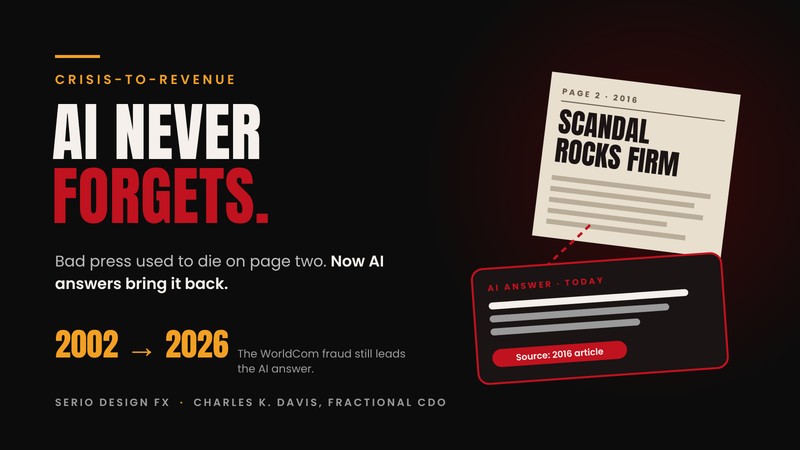
Your crisis did not end. It just went quiet. AI is about to make it loud again.
For twenty years, the rule was simple. Bad press drops to page two of Google, and page two is where stories go to die. That rule is gone. AI answers do not care what ranks. They care what is well documented. And nothing is better documented than a scandal.
A company can recover its stock price faster than it can recover its story.
I was a QA consultant on MCI/WorldCom work while the collapse was building. From the outside, it looked like a giant. From where I sat, the signs were there. Instead of pay raises, people got stock options. Paper promises in place of real money. People held those options like they were gold.
At the top, Bernie Ebbers was running a different game. When the accounting fraud surfaced in 2002, it came to about $11 billion. The options were worth nothing. The careers tied to that name took the hit too.
Here is the part people forget. MCI went on. It came out of bankruptcy and was later bought by Verizon. The business kept running. The story never did. Ask any AI today about WorldCom, and the first thing you get is the fraud. Not the networks. Not the people. The fraud.
That is what a story does when nobody tells a better one. It wins by default.
AI repeats your worst moment because your worst moment has the most sources.
In July 2026, Anthony Will wrote in Search Engine Land about a Midwest grocery chain. One store had a customer service problem in the mid-2010s. It was fixed. The story faded from normal search. Then AI Overviews started citing that old article when people asked about the chain. A ten-year-old problem became the headline again.
This is not a glitch. It is how these systems work. A crisis gets news coverage, follow-ups, opinion pieces and forum threads. The recovery gets a press release. When an AI builds an answer, it pulls from the pile that is bigger and more trusted. The crisis pile wins.
The layoff you handle badly this year is the AI answer about your company for the next ten.
TrueUp's tracker counted 196,349 people hit by tech layoffs in 2026 as of October 23. On October 26, Microsoft offered a Voluntary Exit Offer to about 60,000 employees. Every one of these moves creates a public record. Glassdoor reviews. LinkedIn posts from people who got a cold email. Reddit threads. News stories about how it was done.
All of that is fuel. In two years, a candidate will ask an AI, "Is this a good place to work?" A buyer will ask, "Can I trust this vendor?" The answer will be built from what got written this month.
Most companies are not watching. They track press mentions and social posts. They do not ask the AI tools what they say. That gap is the crisis.
Recoverable, if you build the record before the AI builds it for you.
You cannot delete a true story. You should not try. What you can do is make the full story easier to find than the worst chapter. That means documented changes, named people, real numbers and third-party proof. Things an AI can cite.
WorldCom never got that chance. The fraud was the whole story, and nobody wrote the next one. Your company does not have to repeat that.
Every company with a past now needs someone who knows how to manage what AI says about it.
This is a new service line with clear buyer pain:
Consultants, agencies and fractional executives who learn this now will own the category while everyone else is still chasing page one.
Rarely by asking. You change the answer by changing the sources. Publish clear, verifiable content about what changed, and earn mentions from trusted third parties.
Start with ChatGPT, Google Gemini and AI Overviews, Perplexity and Microsoft Copilot. Ask the questions a buyer, a candidate and a journalist would ask.
At least monthly, and right after any major news. Model updates can change answers without warning.
Yes. An executive tied to a failed company or a public layoff carries that story into every AI search of their name.
Want to know if your crisis is recoverable or fatal? Start here: Brand Crisis: Recoverable vs Fatal.
Ready to build the system? The companion playbook lays out the 90-day plan, step by step: The AI Answer Audit: A 90-Day Plan to Change What AI Says About Your Brand.
M.A.D. (Maverick Advantage Design) builds the brand. M.A.P. (Maverick Advantage Platform) is the content engine that keeps your real story in front of the people and the machines that matter.
M.A.D. Designs Your Brand. M.A.P. Makes You Known For It.
Stop Reading. Start Seeing.
Charles K. Davis
Fractional CDO, Serio Design FX